MR-03/12/25-CB/CS – NB-IoT/LTE-M Microwave Radar Distance Sensor User Manual
MR-03/12/25-CB/CS – NB-IoT/LTE-M Microwave Radar Distance Sensor User Manual
1. Introduction
1.1 What is NB-IoT/LTE-M Microwave Radar distance Sensor
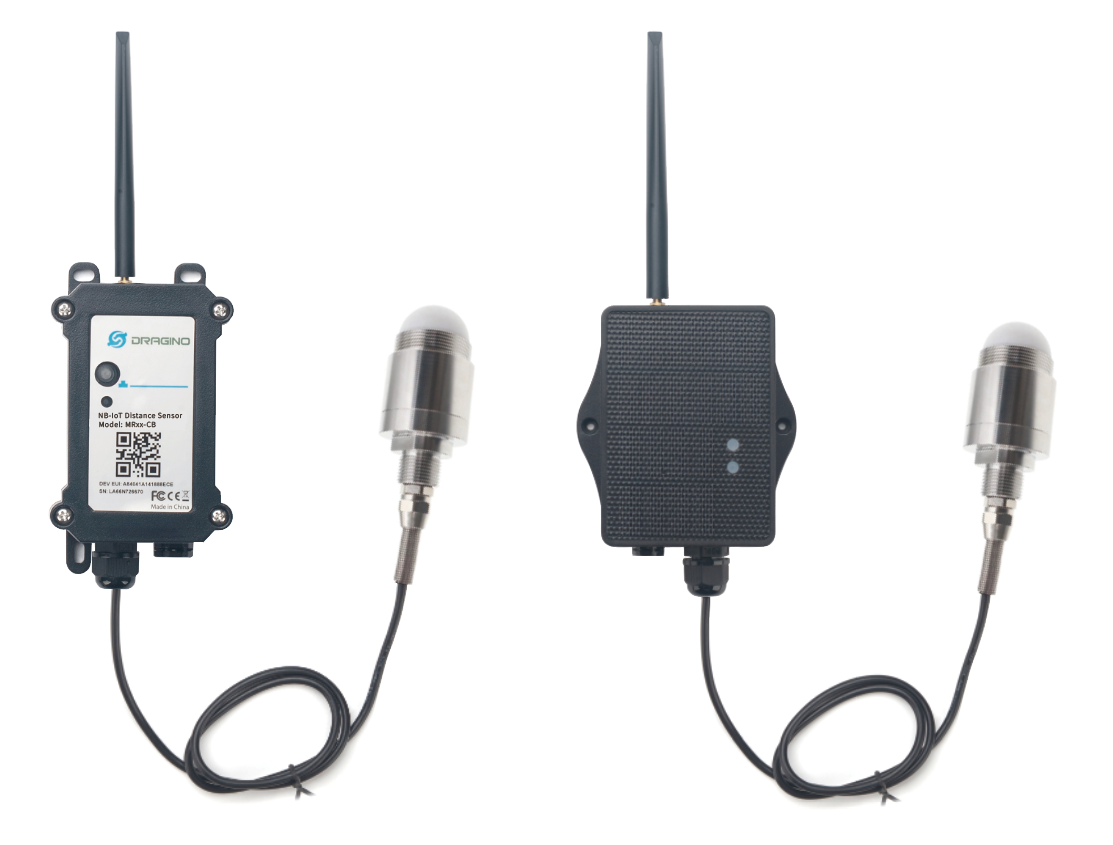
The Dragino MR-03/12/25-CB/CS is a NB-IoT/LTE-M Microwave Radar distance Sensor for Internet of Things solution. It uses 80Ghz Microwave to detect the distance between sensor and diferent objects. Diferent from ultrosonic or Lidar measurement. Microwave Radar is more reliable for condensation / dusty environment. It can sense correct distance even there is water or think dust on top of the sensor.
The MR-03/12/25-CB/CS can be applied to scenarios such as horizontal distance measurement, parking management system, object proximity and presence detection, intelligent trash can management system, robot obstacle avoidance, automatic control, sewer, etc.
MR-03/12/25-CB/CS supports different uplink methods including MQTT, MQTTs, UDP, TCP or CoAP for different application requirement, and support uplinks to various IoT Servers.
MR-03/12/25-CB/CS supports BLE configure and OTA update which make user easy to use.
MR-03/12/25-CB/CS is powered by **8500mAh Li-SOCI2 battery or solar powered + Li-ion battery **, it is designed for long-term use up to several years.
MR-03/12/25-CB/CS has optional built-in SIM card and default IoT server connection version. Which makes it works with simple configuration.
1.2 Features
- For -NB/NS Bands: B1/B2/B3/B4/B5/B8/B12/B13/B17/B18/B19/B20/B25/B28/B66/B70/B85
- For -CB/CS Bands: B1/B2/B3/B4/B5/B8/B12/B13//B18/B19/B20/B25/B28/B66/B71/B85
- CAT-M1 / LTE-M Bands: B1/B2/B3/B4/B5/B8/B12/B13/B18/B19/B20/B25/B26/B27/B28/B66/B85
- Ultra-low power consumption
- 80GHz Microwave Radar for distance detection
- Measure Range : 3m: 200 ~ 3000mm; 12m: 200 ~ 12000mm; 25m: 200 ~ 25000mm
- Accuracy: ± 20mm
- Resolution: 1mm
- Measurement Angle : 7.6 degrees horizontal and 7.6 degrees vertical
- Multiply Sampling and one uplink
- GNSS for Location Report
- Uplink via MQTT, MQTTs, TCP, UDP or CoAP
- Support Bluetooth v5.1 remote configure and update firmware
- Uplink on periodically
- Downlink to change configure
- 8500mAh Battery for long term use
- Nano SIM card slot for NB-IoT SIM
1.3 Specification
Common DC Characteristics:
- Supply Voltage: 2.6v ~ 3.6v
- Operating Temperature: -40 ~ 85°C
Radar probe Spec:
- Measuring Method: FMCW
- Frequency: 80 GHz
- 80GHz Microwave Radar for distance detection
- Measure Range : 3m: 200 ~ 3000mm; 12m: 200 ~ 12000mm; 25m: 200 ~ 25000mm
- Accuracy: ± 20mm
- Resolution: 1mm
- Measurement Angle : 7.6 degrees horizontal and 7.6 degrees vertical
NB-IoT Spec:
NB-IoT Module: BG95-NGFF
Support Bands:
- B1 @H-FDD: 2100MHz
- B2 @H-FDD: 1900MHz
- B3 @H-FDD: 1800MHz
- B4 @H-FDD: 2100MHz
- B5 @H-FDD: 860MHz
- B8 @H-FDD: 900MHz
- B12 @H-FDD: 720MHz
- B13 @H-FDD: 740MHz
- B17 @H-FDD: 730MHz
- B18 @H-FDD: 870MHz
- B19 @H-FDD: 870MHz
- B20 @H-FDD: 790MHz
- B25 @H-FDD: 1900MHz
- B28 @H-FDD: 750MHz
- B66 @H-FDD: 2000MHz
- B70 @H-FDD: 2000MHz
- B85 @H-FDD: 700MHz
Battery:
- Li/SOCI2 un-chargeable battery
- Capacity: 8500mAh
- Self Discharge: <1% / Year @ 25°C
- Max continuously current: 130mA
- Max boost current: 2A, 1 second
Power Consumption:
- STOP Mode: 10uA @ 3.3v
- Max transmit power: 350mA@3.3v
1.4 Applications
- Horizontal distance measurement
- Liquid level measurement
- Parking management system
- Object proximity and presence detection
- Intelligent trash can management system
- Robot obstacle avoidance
- Automatic control
- Sewer
- Bottom water level monitoring
1.5 Installation
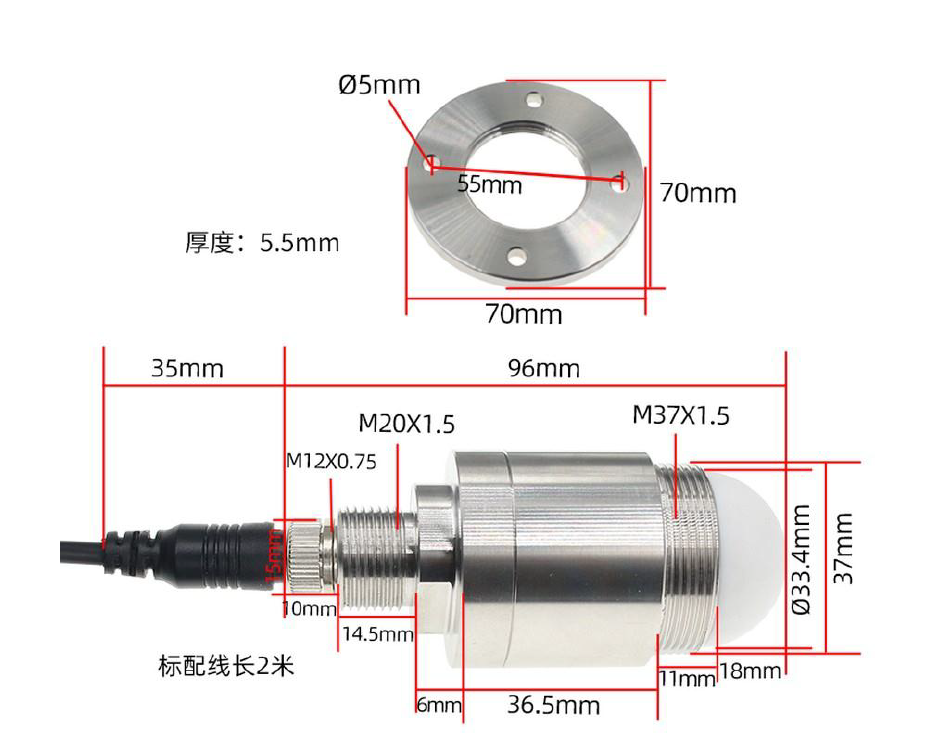
Sensor measure direction and angle is as below. When install the sensor, please make sure the sensor direct to object.
1.6 Sleep mode and working mode
**Deep Sleep Mode: **Sensor doesn't have any NB-IoT activate. This mode is used for storage and shipping to save battery life.
Working Mode: In this mode, Sensor will work as NB-IoT Sensor to Join NB-IoT network and send out sensor data to server. Between each sampling/tx/rx periodically, sensor will be in IDLE mode), in IDLE mode, sensor has the same power consumption as Deep Sleep mode.
1.7 Button & LEDs
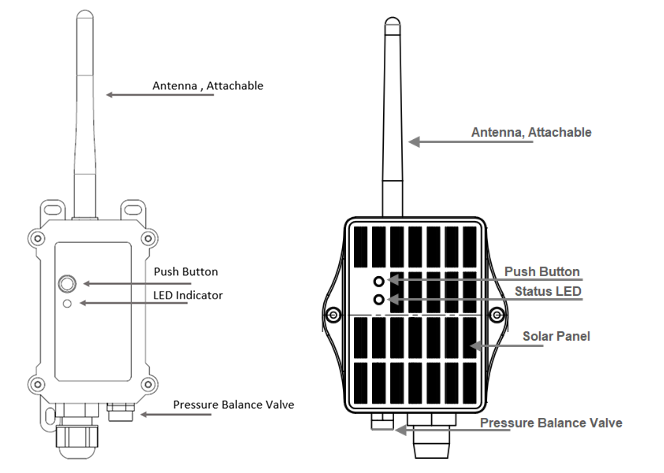
| Behavior on ACT | Function | Action |
|---|---|---|
 1~3s 1~3s | Send an uplink | If sensor has already attached to NB-IoT/CAT-M1 network, sensor will send an uplink packet, blue led will blink once. Meanwhile, BLE module will be active and user can connect via BLE to configure device. |
| >3s | Active Device | Green led will fast blink 5 times, device will enter OTA mode for 3 seconds. And then start to attach NB-IoT/CAT-M1 network. Once sensor is active, BLE module will be active and user can connect via BLE to configure device, no matter if device attach NB-IoT/CAT-M1 network or not. |
 x5 x5 | Deactivate Device | Red led will solid on for 5 seconds. Means device is in Deep Sleep Mode. |
Note: When the device is executing a program, the buttons may become invalid. It is best to press the buttons after the device has completed the program execution.
1.8 BLE connection
MR-03/12/25-CB/CS support BLE remote configure and firmware update.
BLE can be used to configure the parameter of sensor or see the console output from sensor. BLE will be only activate on below case:
- Press button to send an uplink
- Press button to active device.
- Device Power on or reset.
If there is no activity connection on BLE in 60 seconds, sensor will shut down BLE module to enter low power mode.
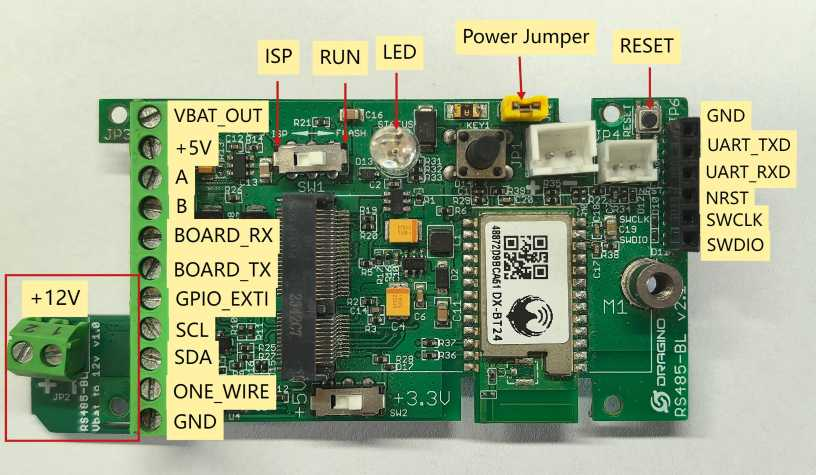
1.9 Pin Definitions , Switch & SIM Direction
1.9.1 Jumper JP2
Power on Device when put this jumper.
1.9.2 BOOT MODE / SW1
1) ISP: upgrade mode, device won't have any signal in this mode. but ready for upgrade firmware. LED won't work. Firmware won't run.
2) Flash: work mode, device starts to work and send out console output for further debug
1.9.3 Reset Button
Press to reboot the device.
1.9.4 SIM Card Direction
See this link. How to insert SIM Card.
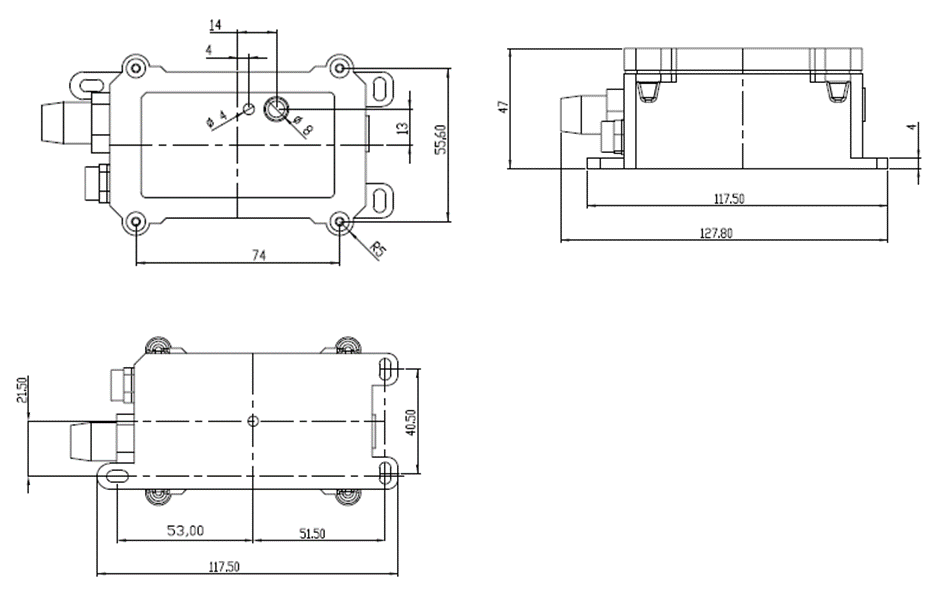
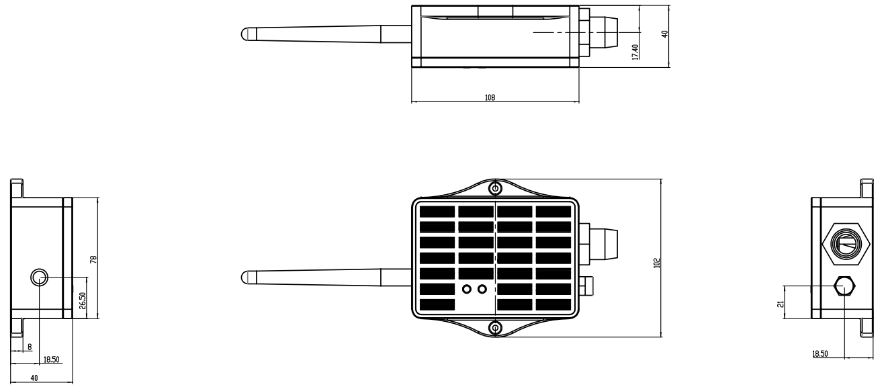
1.10 Mechanical
1.10.1 for CB version
1.10.2 for CS version
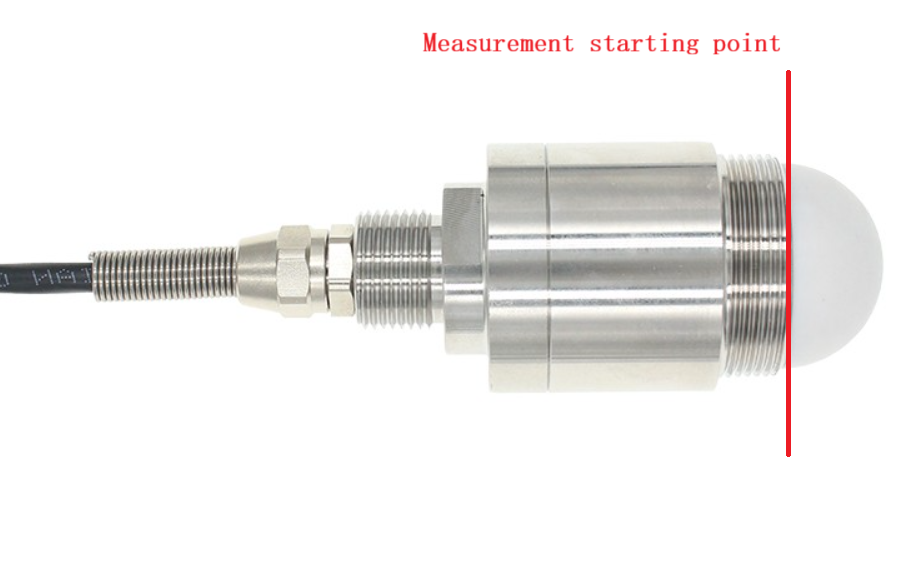
1.11 Measure starting point
2. Use MR-03/12/25-CB/CS to communicate with IoT Server
2.1 Send data to IoT server via NB-IoT network
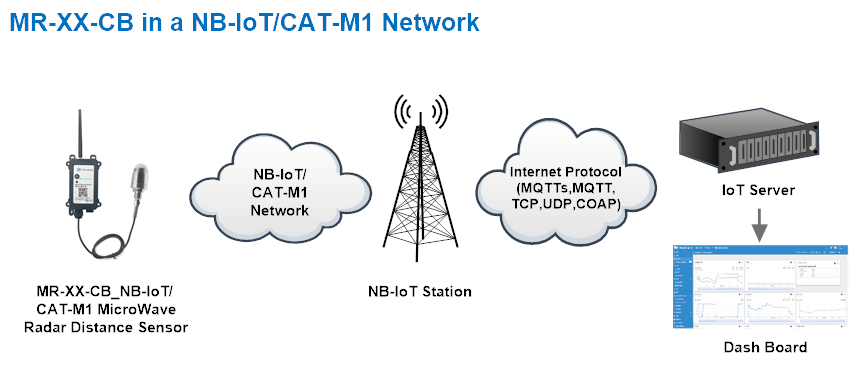
The MR-03/12/25-CB/CS is equipped with a NB-IoT module, the pre-loaded firmware in MR-03/12/25-CB/CS will get environment data from sensors and send the value to local NB-IoT network via the NB-IoT module. The NB-IoT network will forward this value to IoT server via the protocol defined by MR-03/12/25-CB/CS.
Below shows the network structure:
There are two version: -GE and -1T version of MR-03/12/25-CB/CS.
GE Version: This version doesn't include SIM card or point to any IoT server. User needs to use AT Commands to configure below two steps to set MR-03/12/25-CB/CS send data to IoT server.
-
Install NB-IoT SIM card and configure APN. See instruction of Attach Network.
-
Set up sensor to point to IoT Server. See instruction of Configure to Connect Different Servers.
Below shows result of different server as a glance.
| Servers | Dash Board | Comments |
|---|---|---|
| Node-Red | 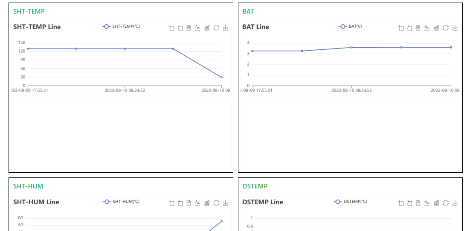 | |
| DataCake | 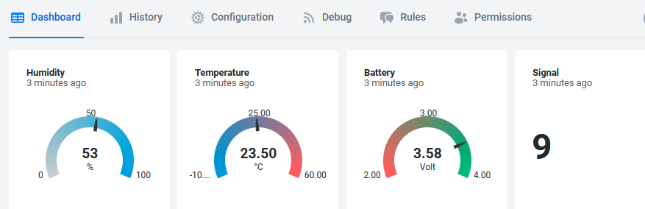 | |
| Tago.IO | ||
| General UDP | Raw Payload. Need Developer to design Dash Board | |
| General MQTT | Raw Payload. Need Developer to design Dash Board | |
| ThingSpeak | 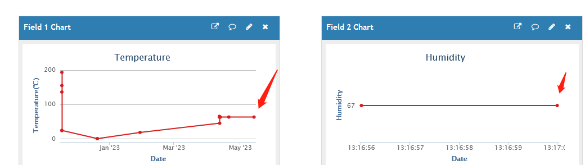 | |
| ThingsBoard | 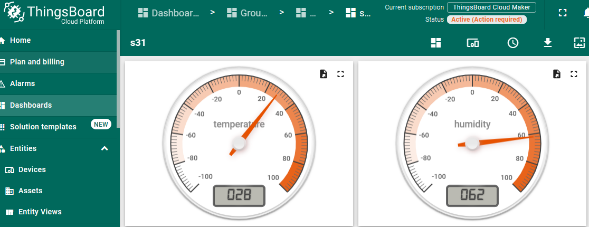 |
1T Version: This version has 1NCE SIM card pre-installed and configure to send value to ThingsEye. User Just need to select the sensor type in ThingsEyeand Activate MR-03/12/25-CB/CS and user will be able to see data in ThingsEye. See here for ThingsEye Config Instruction.
2.2 Payload Types
To meet different server requirement, MR-03/12/25-CB/CS supports different payload type.
Includes:
-
General JSON format payload. (Type=5)
-
HEX format Payload. (Type=0)
-
ThingSpeak Format. (Type=1)
-
ThingsBoard Format. (Type=3)
User can specify the payload type when choose the connection protocol. Example:
AT+PRO=1,0 // Use COAP Connection & hex Payload
AT+PRO=1,5 // Use COAP Connection & Json Payload
AT+PRO=2,0 // Use UDP Connection & hex Payload
AT+PRO=2,5 // Use UDP Connection & Json Payload
AT+PRO=3,0 // Use MQTT Connection & hex Payload
AT+PRO=3,5 // Use MQTT Connection & Json Payload
AT+PRO=4,0 // Use TCP Connection & hex Payload
AT+PRO=4,5 // Use TCP Connection & Json Payload
2.2.1 General Json Format(Type=5)
This is the General Json Format. As below:
{"IMEI":"868508065628110","Model":"MR03/12/25-CB","distance":200,"interrupt":0,"interrupt_level":0,"battery":3.34,"signal":24,"latitude":0.000000,"longitude":0.000000,"gps_time":"1970-01-01T00:00:00Z","1":[0,"2025-12-05T05:29:42Z"],"2":[0,"2025-12-05T05:14:42Z"],"3":[0,"2025-12-05T04:59:42Z"],"4":[0,"2025-12-05T04:44:42Z"],"5":[0,"2025-12-05T04:29:42Z"],"6":[0,"2025-12-05T04:14:42Z"],"7":[624,"2025-12-02T08:39:21Z"],"8":[624,"2025-12-02T08:24:21Z"]}
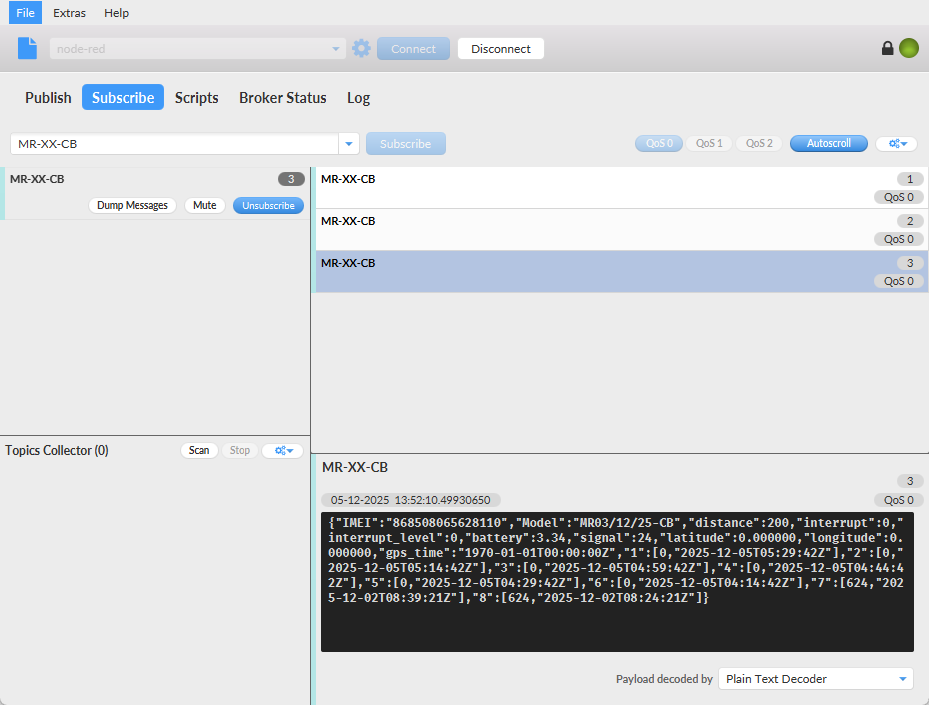
Notice, from above payload:
- Distance , Interrupt, Interrupt_level, Battery, Signal, time, Latitude, Longitude & GPS_Time are the value at uplink time.
- Json entry 1 ~ 8 are the last 1 ~ 8 sampling data as specify by **AT+CLOCKLOG=1,65535,15,8 ** Command. Each entry includes (from left to right): Distance, Sampling time.
2.2.2 HEX format Payload(Type=0)
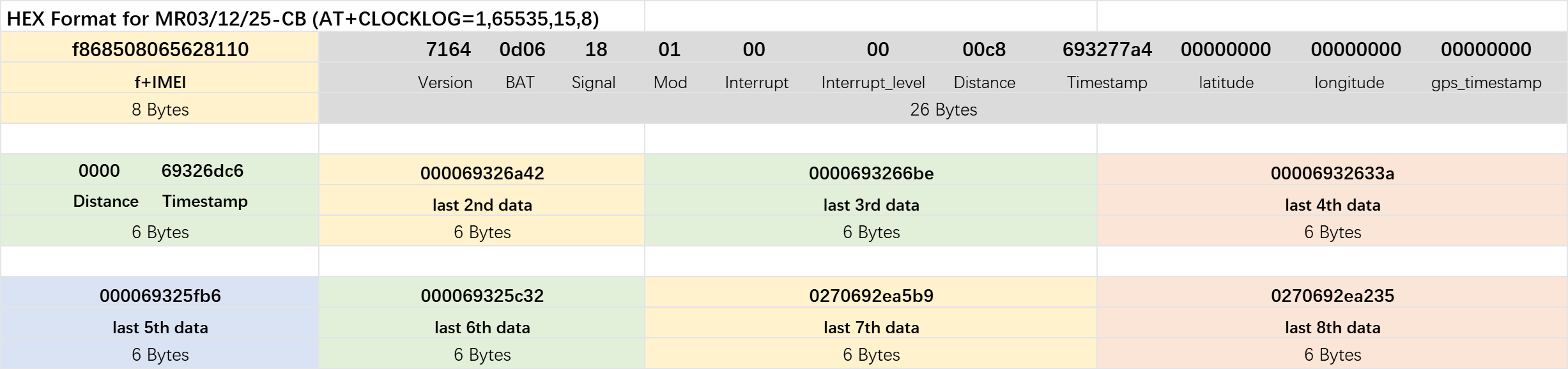
This is the HEX Format. As below:
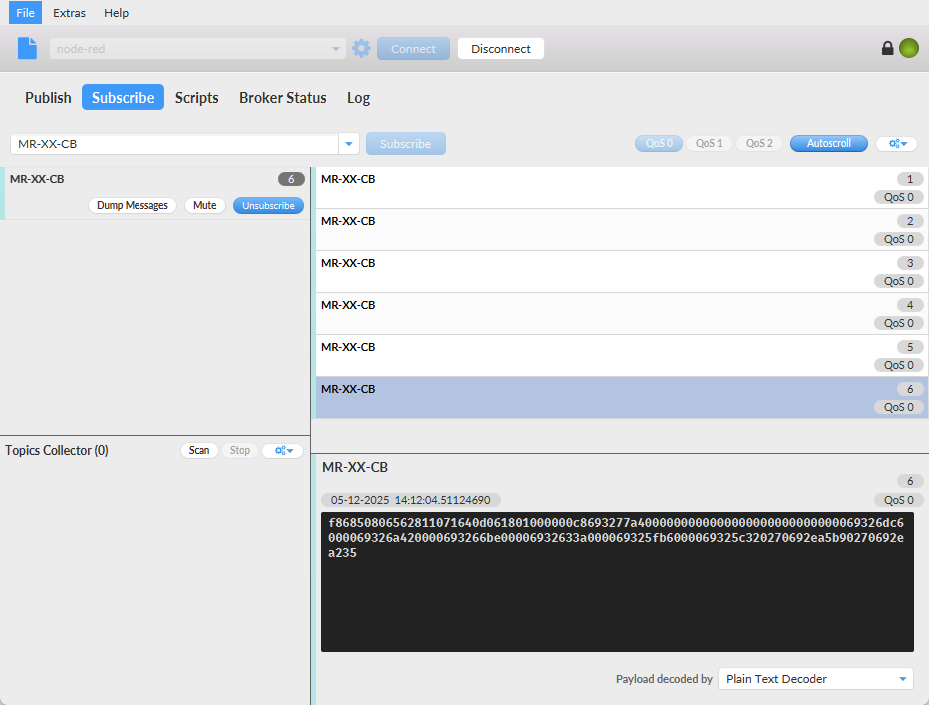
f86850806562811071640d061801000000c8693277a4000000000000000000000000000069326dc6000069326a420000693266be00006932633a000069325fb6000069325c320270692ea5b90270692ea235
If we use the MQTT client to subscribe to this MQTT topic, we can see the following information when the NB sensor uplink data.
Version:
These bytes include the hardware and software version.
Higher byte: Specify Sensor Model: 0x71 for MR-03/12/25-CB/CS.
Lower byte: Specify the software version: 0x64=100, means firmware version 1.0.0
BAT (Battery Info):
Check the battery voltage for MR-03/12/25-CB/CS.
Ex1: 0x0d06 = 3334mV
Ex2: 0x0B49 = 2889mV
Signal Strength:
NB-IoT Network signal Strength.
Ex1: 0x18 = 24
0 -113dBm or less
1 -111dBm
2...30 -109dBm... -53dBm
31 -51dBm or greater
99 Not known or not detectable
**Distance: **
Measure distance. The detection range comprises three measurement ranges:
MR-03: 200 mm to 3000 mm;
MR-12: 200 mm to 12000 mm;
MR-25: 200 mm to 25000 mm.
For example, if the data you get from the register is 0x0B 0x05, the distance between the sensor and the measured object is** **
0B05(H) = 2821 (D) = 2821 mm.
-
If the sensor value is 0x0000, it means system doesn't detect ultrasonic sensor.
-
If the sensor value equals 0x00C8 (200 mm), the sensor value is invalid. All values ≤ 200 mm will be set to 0x00C8 (200 mm), indicating the value is invalid
Interrupt:
This data field shows if this packet is generated by interrupt or not.
Example:
0x00: Normal uplink packet.
0x01: Interrupt Uplink Packet.
Interrupt level:
This byte shows whether the interrupt is triggered by a high or low level.
Ex1: 0x00 Interrupt triggered by falling edge (low level)
**Ex2: **0x01 Interrupt triggered by rising edge (high level)
Latitude:
**Example: **0x015a7886(H)=22706310(D)=22.706150
Longitude:
**Example: **0x06cf341e(H)=114242590(D)=114.242830
**Timestamp & GPS_Timestamp: **
Unit Timestamp Example: 6653ddb4(H) = 1716772276(D)
Put the decimal value into this link(https://www.epochconverter.com)) to get the time.
2.2.3 ThingsBoard Payload(Type=3)
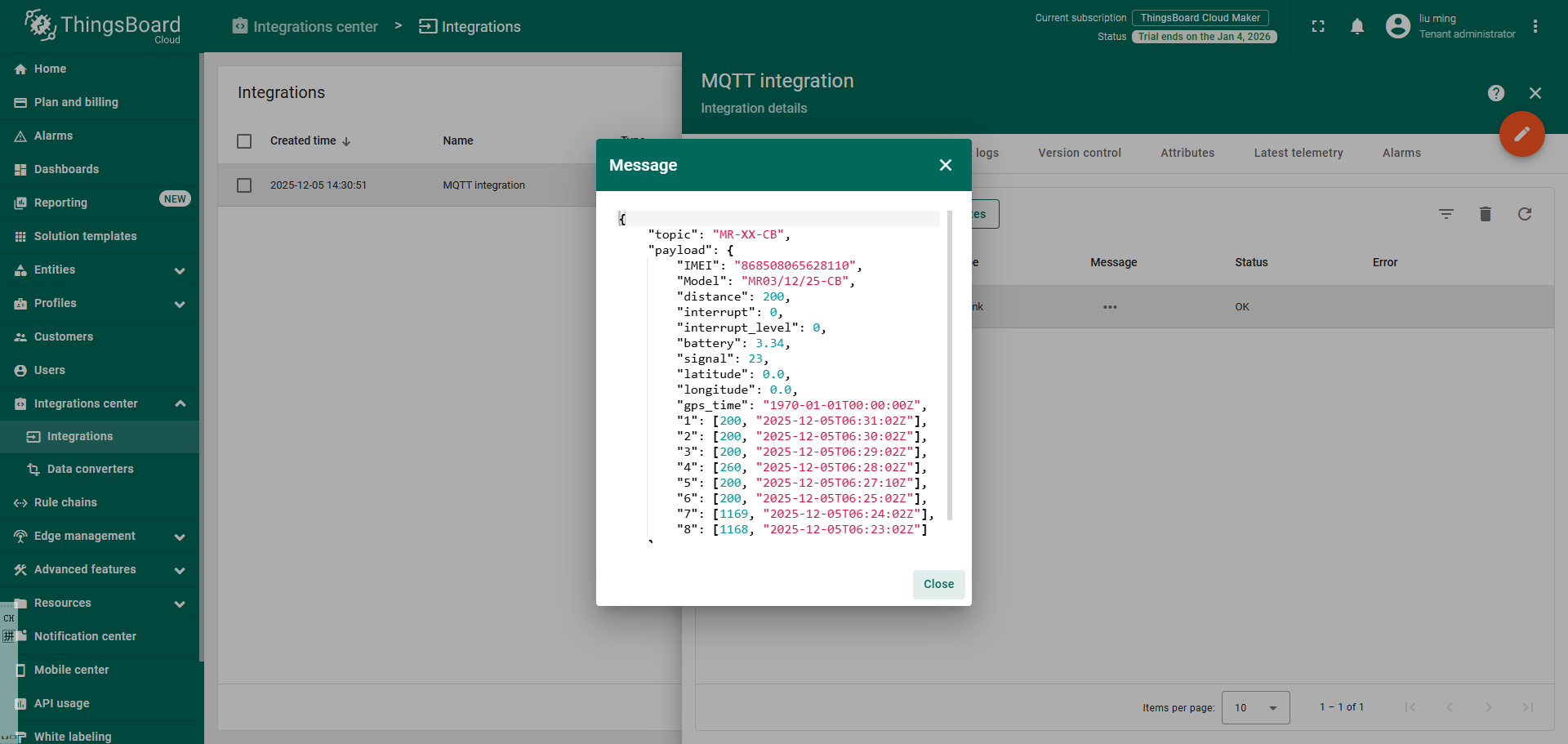
Type3 payload special design for ThingsBoard, it will also configure other default server to ThingsBoard.
{ "topic": "MR-XX-CB", "payload": { "IMEI": "868508065628110", "Model": "MR03/12/25-CB", "distance": 200, "interrupt": 0, "interrupt_level": 0, "battery": 3.34, "signal": 23, "latitude": 0.0, "longitude": 0.0, "gps_time": "1970-01-01T00:00:00Z", "1": [200, "2025-12-05T06:31:02Z"], "2": [200, "2025-12-05T06:30:02Z"], "3": [200, "2025-12-05T06:29:02Z"], "4": [260, "2025-12-05T06:28:02Z"], "5": [200, "2025-12-05T06:27:10Z"], "6": [200, "2025-12-05T06:25:02Z"], "7": [1169, "2025-12-05T06:24:02Z"], "8": [1168, "2025-12-05T06:23:02Z"] } }
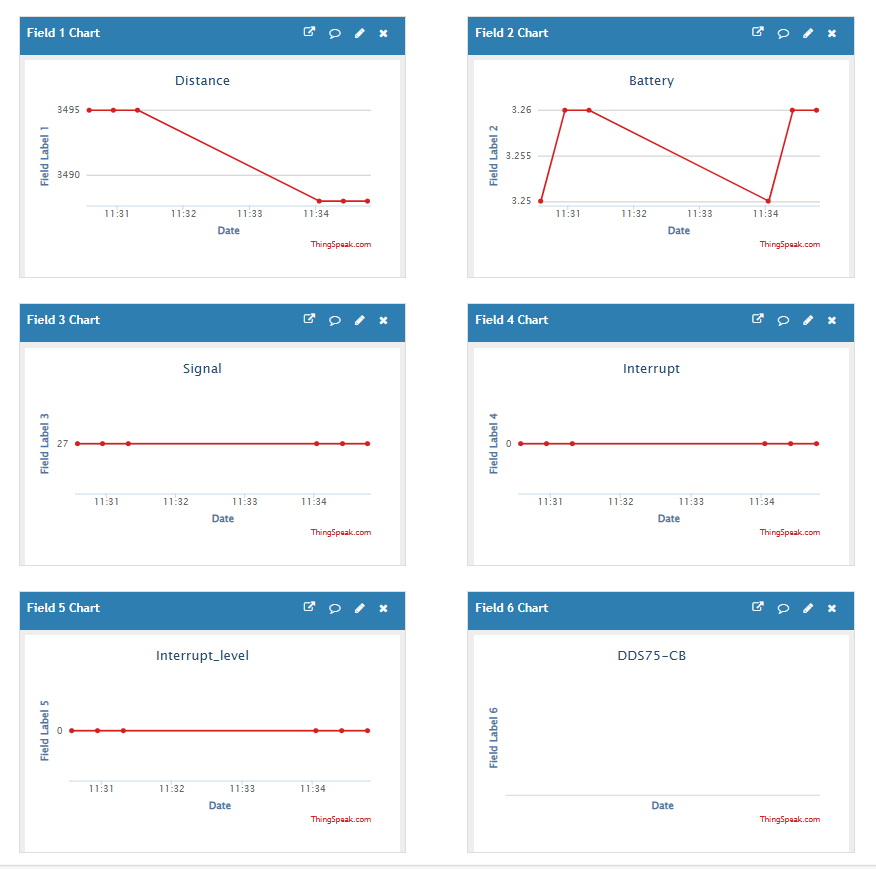
2.2.4 ThingSpeak Payload(Type=1)
This payload meets ThingSpeak platform requirement. It includes only four fields. Form 1~3 are:
Distance, Battery & Signal. This payload type only valid for ThingsSpeak Platform.
As below:
field1=Distance value&field2=Battery value&field3=Signal value&field4=Interrupt value&field5=Interrupt_level value
3. Configure MR-03/12/25-CB/CS
3.1 Configure Methods
MR-03/12/25-CB/CSB supports below configure method:
-
AT Command via Bluetooth Connection (Recommended): BLE Configure Instruction.
-
AT Command via UART Connection : See UART Connection.
3.2 Serial Access Password
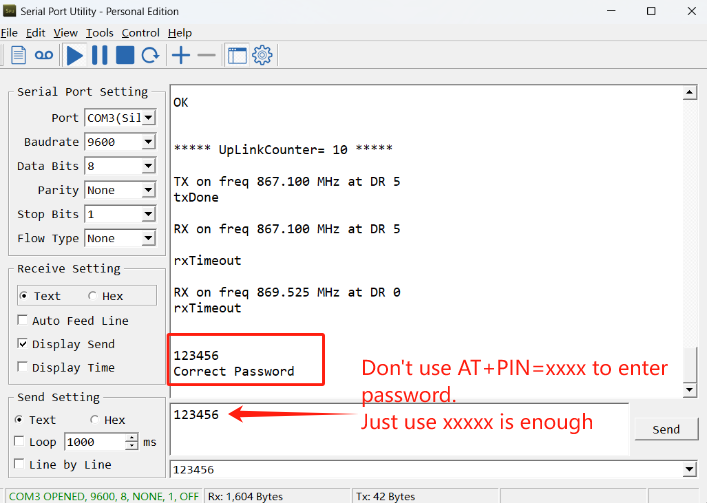
After the Bluetooth or UART connection is successful, use the Serial Access Password to enter the AT command window.
The label on the box of the node will print the initial password: AT+PIN=xxxxxx, and directly use the six-digit password to access the AT instruction window.
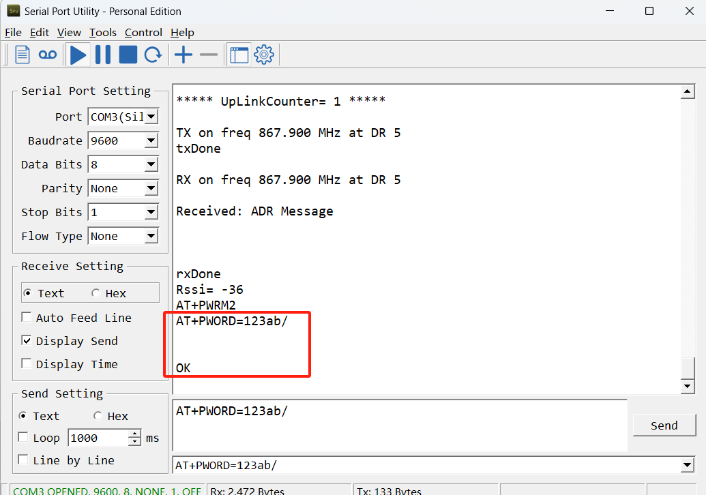
If you need to change the password, use AT+PWORD=xxxxxx (6 characters), -CB nodes only support lowercase letters.
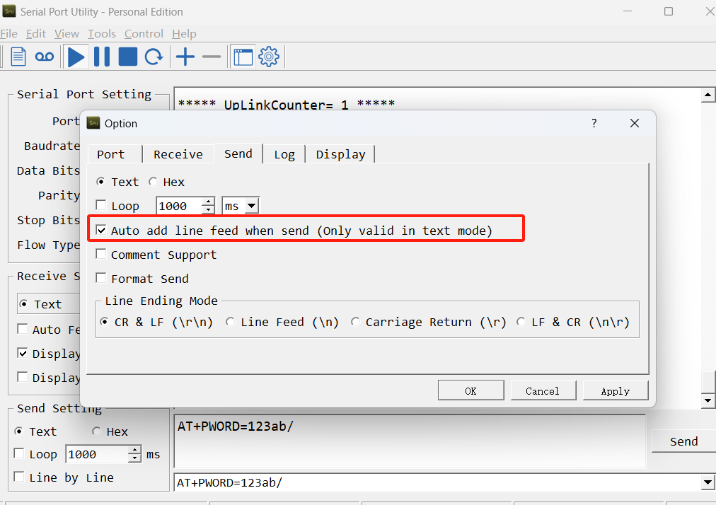
Note: After entering the command, you need to add a line break, and you can also set automatic line breaks in the Bluetooth tool or UART connection tool.
3.3 AT Commands Set
AT+<CMD>? : Help on <CMD>
AT+<CMD> : Run <CMD>
AT+<CMD>=<value> : Set the value
AT+<CMD>=? : Get the value
AT : Attention
AT? : Short Help
AT+MODEL : Get module information
ATZ : Trig a reset of the MCU
AT+CFGMOD : Working mode selection
AT+DEUI : Get or set the Device ID
AT+CFG : Print all settings
AT+SERVADDR: Get or Set the Server address
AT+TDC : Get or set the application data transmission interval in s
AT+INTMOD : Get or Set the trigger interrupt mode (0:input,1:falling or rising,2:falling,3:rising)
AT+APN : Get or set the APN
AT+5VT : Get or Set extend the time of 5V power
AT+PRO : Get or Set usage agreement (1:COAP,2:UDP,3:MQTT,4:TCP)
AT+RXDL : Get or Set the receiving time
AT+LDDSALARM:Get or Set alarm of LDDS and NMDS
AT+GETSENSORVALUE : Returns the current sensor measurement
AT+DNSCFG : Get or Set DNS Server
AT+CSQTIME : Get or Set the time to join the network
AT+GDNS : Get or Set the DNS
AT+TLSMOD : Get or Set the TLS mode
AT+SLEEP : Get or Set the sleep mode
AT+IPTYPE : Set the IPv4 or IPv6
AT+QSW : Power on and power off BG95 module
AT+GETLOG : Print serial port logs
AT+CLOCKLOG: Get or set SHT record time
AT+QBAND: Get or set Frequency Band
AT+IOTMOD: Configure Network Category to be Searched for under LTE RAT
MQTT Management
AT+CLIENT : Get or Set the MQTT clientID
AT+UNAME : Get or Set the MQTT Username
AT+PWD : Get or Set the MQTT password
AT+PUBTOPIC: Get or set MQTT publishing topic
AT+SUBTOPIC: Get or set MQTT subscription topic
AT+MQOS : Set the QoS level of MQTT
Coap Management
AT+URI1: Get or set CoAP option 1
AT+URI2: Get or set CoAP option 2
AT+URI3: Get or set CoAP option 3
AT+URI4: Get or set CoAP option 4
AT+URI5: Get or set CoAP option 5
AT+URI6: Get or set CoAP option 6
AT+URI7: Get or set CoAP option 7
AT+URI8: Get or set CoAP option 8
GPS
AT+GNSST : Extend the time to turn on GNSS
AT+GPS : Turn off and on GPS
AT+GTDC : Get or set GPS positioning interval in units of h
Information
AT+CDP : Read or Clear cached data
AT+LDATA : Get the last upload data
AT+PWORD : Get or set the System password
AT+FDR1 : Reset parameters to factory default values except for passwords
AT+FDR : Reset Parameters to Factory Default
3.4 Test Uplink and Change Update Interval
By default, Sensor will send uplinks every 2 hours.
User can use below commands to change the uplink interval.
AT Command: AT+TDC
Example: AT+TDC=7200 // Set Update Interval to 7200 seconds
Downlink Commands: 0x01
Format: Command Code (0x01) followed by 3 bytes.
Example: 12 hours= 43200 seconds 43200(D)=0xA8C0(H)
Downlink Payload: `01 00 A8 C0` // AT+TDC=43200, Set Update Interval to 12 hours.
Note: User can also push the button for more than 1 seconds to activate an uplink.
3.5 Set the working mode
Feature: Working mode selection
AT Command: AT+CFGMOD
Example: AT+CFGMOD=1 // Set the working mode to 1(Only default mode 1 is available).
Downlink Commands: 0x02
Format: Command Code (0x02) followed by 1 byte.
Example: Downlink Payload: 02 01// AT+CFGMOD=1
3.6 Set the receiving time
Feature: Extend the receiving time
AT Command: AT+RXDL
Example: AT+RXDL=1000 // Set the receiving time delay to 1000ms
Downlink Commands: 0x03
Format: Command Code (0x03) followed by 3 bytes.
Example: Downlink Payload: 03 00 03 E8// AT+RXDL=1000
3.7 Reset
Feature: Trig a reset of the MCU.
AT Command: ATZ
Downlink Commands: 0x04FF
3.8 +5V
Feature: Set extend the time of 5V power.
AT Command: AT+5VT
Example: AT+5VT=2000 // Set extend the time of 5V power to 2000 ms
Downlink Commands: 0x05
Format: Command Code (0x05) followed by 3 bytes.
Example: Downlink Payload: 05 00 07 D0// AT+5VT=2000
3.9 Trggier an uplink by external interrupt
MR-03/12/25-CB/CS has an external trigger interrupt function. Users can use the GPIO_EXTI pin to trigger the upload of data packets.
AT command:
-
**AT+INTMOD ** // Set the trigger interrupt mode
-
**AT+INTMOD=0 ** // Disable Interrupt
-
**AT+INTMOD=1 ** // Trigger by rising and falling edge
-
**AT+INTMOD=2 ** // Trigger by falling edge
-
**AT+INTMOD=3 ** // Trigger by rising edge
Downlink Commands: 0x06
Format: Command Code (0x06) followed by 3 bytes.
Example1: Downlink Payload: 06 00 00 01// AT+INTMOD=1
Example2: Downlink Payload: 06 00 00 03// AT+INTMOD=3
3.10 Set the QoS level
This command is used to set the QoS level of MQTT.
AT command:
- **AT+MQOS=xx **// 0~2
Downlink command: 0x07
Format: Command Code (0x07) followed by 1 byte.
Ex1: Downlink payload: 0x0700 // AT+MQOS=0
Ex2: Downlink payload: 0x0701 // AT+MQOS=1
3.11 Clock logging
Sometimes when we deploy lots of end nodes in field. We want all sensors sample data at the same time, and upload these data together for analyze. In such case, we can use clock loging feature.
We can use this command to set the start time of data recording and the time interval to meet the requirements of the specific collection time of data.
AT command: AT+CLOCKLOG=a,b,c,d
a: 0: Disable Clock logging. ** 1: **Enable Clock Logging
**b: **Specify First sampling start second: range **(0 ~ 3599, 65535) ** // **Note: **If parameter b is set to 65535, the log period starts after the node accesses the network and sends packets.
**c: **Specify the sampling interval: range (0 ~ 255 minutes)
**d: **How many entries should be uplink on every TDC (max 32)
Note: To disable clock recording, set the following parameters: AT+CLOCKLOG=1,65535,0,0
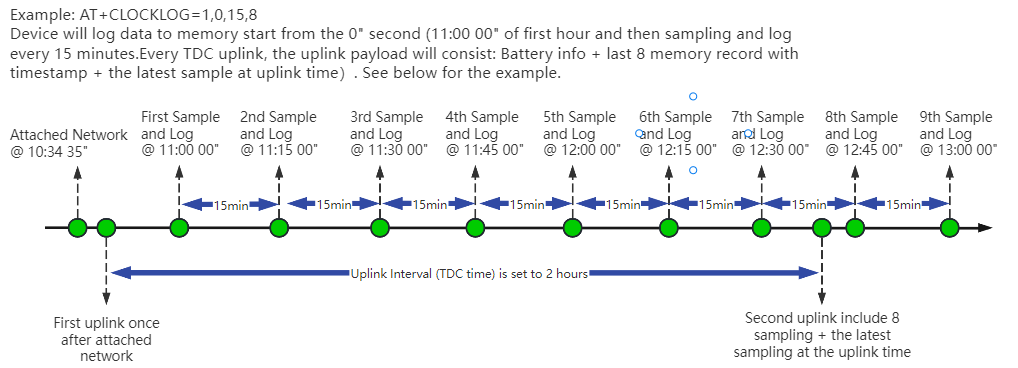
Example:
AT+CLOCKLOG=1,65535,1,5
After the node sends the first packet, data is recorded to the memory at intervals of 1 minute. For each TDC uplink, the uplink load will include: battery information + the last 5 memory records (payload + timestamp).
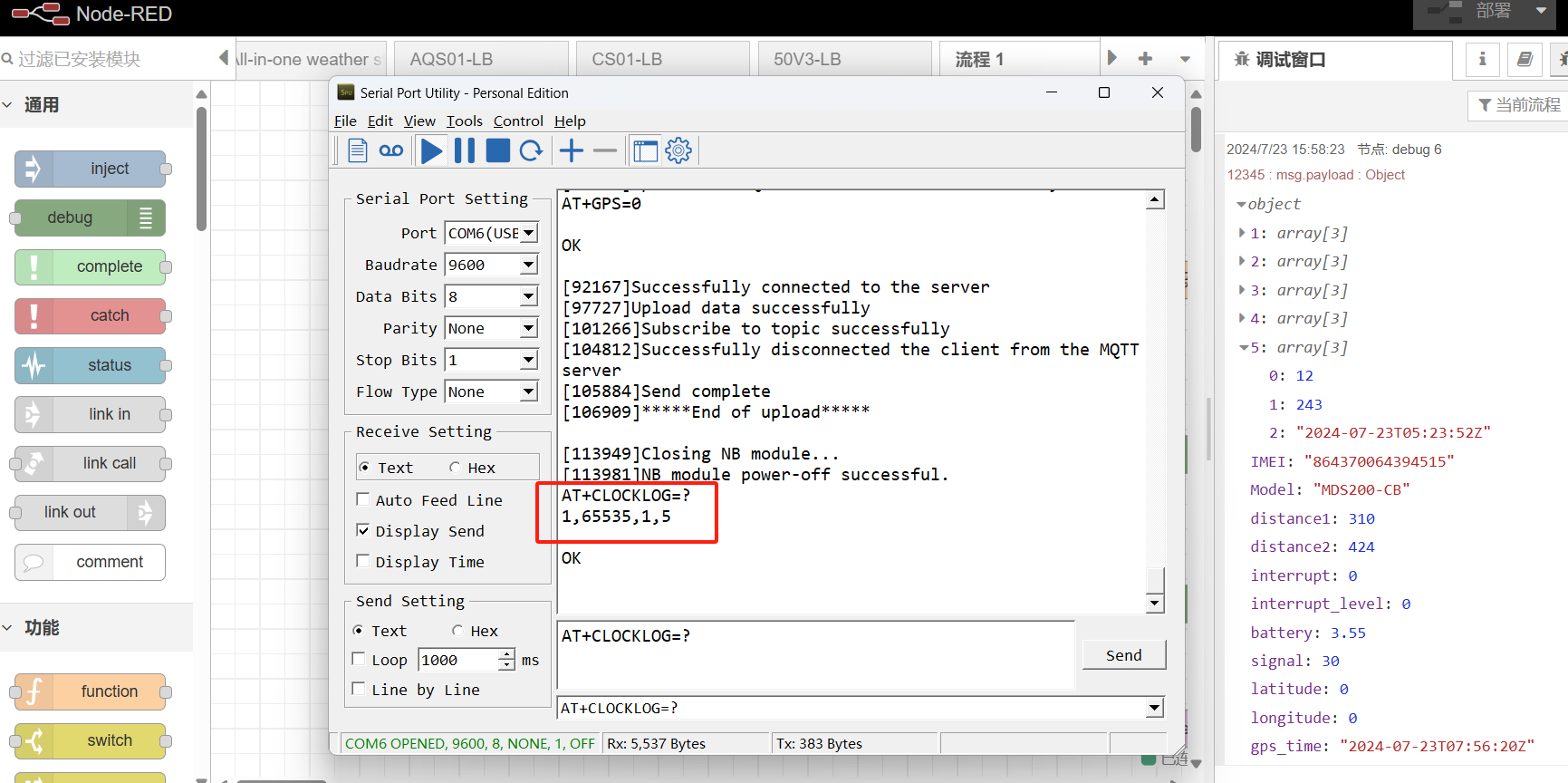
Note: Users need to synchronize the server time before configuring this command. If the server time is not synchronized before this command is configured, the command takes effect only after the node is reset.
Downlink command: 0x08
Format: Command Code (0x08) followed by 5 bytes.
- Example 1: Downlink Payload:** 08 01 FFFF 0F 08** // Set SHT record time: AT+CLOCKLOG=1,65535,15,8
- Example 2: Downlink Payload:** 08 01 04B0 0F 08** // Set SHT record time: AT+CLOCKLOG=1,1200,15,8
Note: When entering the downlink payload, there must be no Spaces between bytes.
3.12 Set the TLS mode
Refer to this link (MQTT Connection to send data to Tago.io)to use the TLS mode.
AT Command: AT+TLSMOD
**Example 1: ** AT+TLSMOD=0,0 // Disable TLS Mode.
Example 2: AT+TLSMOD=1,0 // No authentication
                 AT+TLSMOD=1,1   // Perform server authentication

                 AT+TLSMOD=1,2   //  Perform server and client authentication if requested by the remote server
Downlink command: 0x09
Format: Command Code (0x09) followed by 2 bytes.
Example1: Downlink Payload: 09 00 00// AT+TLSMOD=0,0
Example2: Downlink Payload: 09 01 02// AT+TLSMOD=1,2
3.13 Set GNSS open time
Extend the time to turn on GNSS. The automatic GPS location time is extended when the node is activated.
AT Command: AT+GNSST
Example: AT+GNSST=30 // Set the GPS positioning time to 30 seconds
Downlink command: 0x10
Format: Command Code (0x10) followed by 2 bytes.
Example: Downlink Payload: 10 00 1E// AT+GNSST=30
3.14 Turn on/off GPS
**AT Command: AT+GPS **
**Ex1: **AT+GPS=0 // Turn off GPS
**Ex2: **AT+GPS=1 // Turn on GPS
Downlink command: 0x11
Format: Command Code (0x11) followed by 1 byte.
Example: Downlink Payload: 11 01// AT+GPS=1
3.15 Set GPS positioning interval
Feature: Set GPS positioning interval (unit: hour).
When GPS is enabled, the node automatically locates and uplinks each time it passes GTDC time after activation.
AT Command: AT+GTDC
Example: AT+GTDC=24 // Set the GPS positioning interval to 24h.
Downlink command: 0x12
Format: Command Code (0x12) followed by 3 bytes.
Example: 24 hours: 24(D)=0x18(H)
Downlink Payload: 12 00 00 18// AT+GTDC=24
3.16 Set the search network time
Feature: Get or Set the time to join the network(unit: minutes).
AT Command: AT+CSQTIME
Example: AT+CSQTIME=10 // Set the search time to 10 minutes.
Downlink command: 0x13
Format: Command Code (0x13) followed by 1 byte.
Example: Downlink Payload: 13 0A// AT+CSQTIME=10
3.17 Set Alarm Distance
On each sampling define by AT+CLOCKLOG=1,65535,15,8 ( default 15 minutes), when the value exceed the range, it will trigger an Alarm and immediately sends a uplink.
AT command: AT+ALARM1
AT+ALARM=AA,BB
- AA: Dec value for Alarm low threshold, BB: Dec value for Alarm high threshold
- When 0xAA=0, and 0xBB≠0, Alarm trigger when higher than max
- When 0xAA≠0, and 0xBB =0xFFFF, Alarm trigger when lower than min
- When 0xAA≠0 and 0xBB≠0, Alarm trigger when higher than max or lower than min
Example:
AT+ALARM=200,300 // For diatance 1, alarm when < 200 or higher than 300.(Min:50cm, Max:2000cm)
Downlink command: 0x0A
Format: Command Code (0x0A) followed by 8 bytes. The first 4 bytes after 0A are set to the limit range of distance 1, and the last 4 bytes after 0A are set to the limit range of distance 2.
**Example: **
Downlink Payload: ** 0A 00 64 00 C8 ** // AT+ALARM1=100,200
Downlink Payload: 0A 00 00 00 00// AT+ALARM=0,0 Distance alarms are not enabled.
3.18 Set the IPv4 or IPv6
This command is used to set IP version.
AT command:
- **AT+IPTYPE=1 **// IPv4
- **AT+IPTYPE=2 **// IPv6
3.19 Configure Network Category to be Searched for under LTE RAT.
AT command: AT+IOTMOD=xx
xx: 0: eMTC
        **1:** NB-IoT

        **2:** eMTC and NB-IoT
3.20 Factory data reset
Two different restore factory Settings configurations.
AT command:
- **AT+FDR **// Reset Parameters to Factory Default.
- **AT+FDR1 **// Reset parameters to factory default values except for passwords.
3.21 Set CoAP option
Feature: Set CoAP option, follow this link to set up the CoaP protocol.
AT command: AT+URI1~AT+URI8
**AT+URI1=11,"i" **// "i/" indicates that the endpoint supports observation mode. In -CB products, fixed setting AT+URI1=11,"i"
**AT+URI2=11,"CoAP endpoint URl" **// 11 is a fixed parameter.
**Example: ** i/13a35fbe-9515-6e55-36e8-081fb6aacf86
AT+URI1=11,"i"
AT+URI2=11,"13a35fbe-9515-6e55-36e8-081fb6aacf86"
--> If multiple groups of CoAP endpoint urls:
AT+URI3=11,"i"
AT+URI4=11,"CoAP endpoint URl"
3.22 Power on / power off BG95 module
This command is used to power on and power off BG95 module.
- AT command: AT+QSW
The module is powered on after the command is sent for the first time, and powered off after the command is sent again.
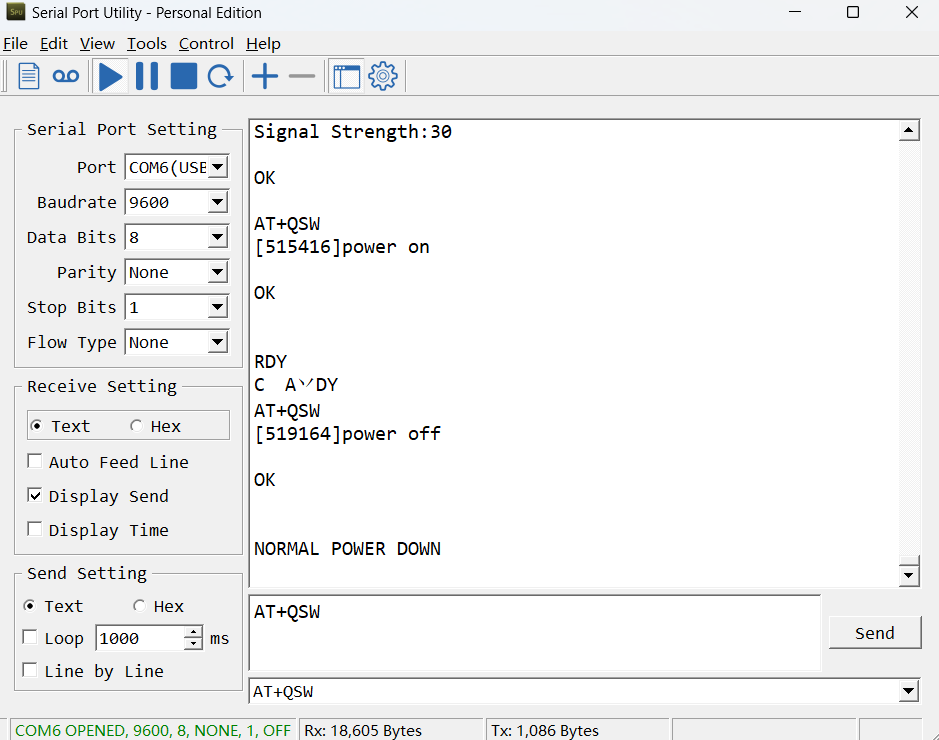
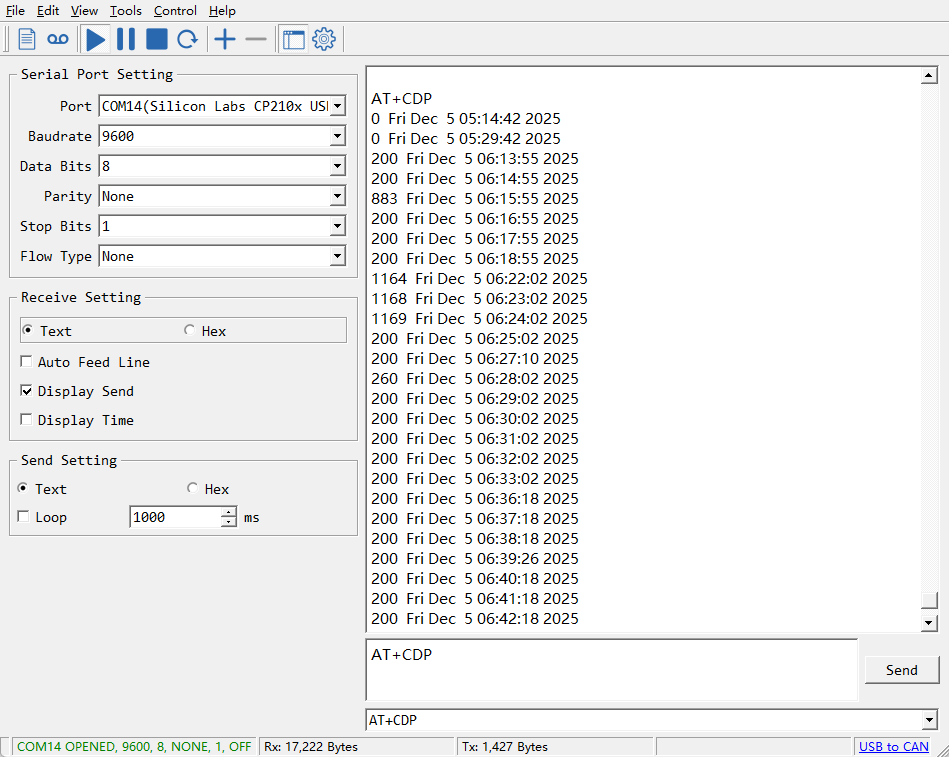
3.23 Example Query saved historical records
- AT command: AT+CDP
This command can be used to search the saved history, recording up to 32 groups of data, each group of historical data contains a maximum of 100 bytes.
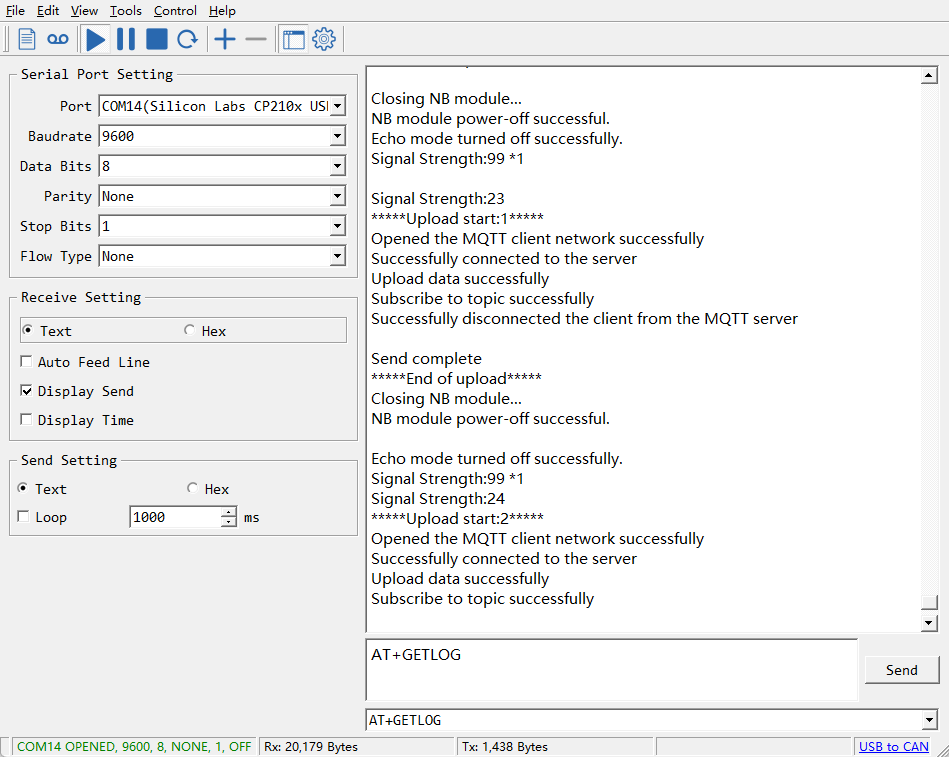
3.24 Uplink log query
- AT command: AT+GETLOG
This command can be used to query upstream logs of data packets.
3.25 Set the downlink debugging mode(Since firmware v1.1.0)
Feature: Enable or disable downlink debugging mode. (Since TE platform update, the platform version selection is no longer needed; only downlink debugging can be toggled.)
AT command: AT+DOWNTE
| Command Example | Function/Parameters | Response/Explanation |
|---|---|---|
| AT+DOWNTE=? | Get current Settings | 0,0 (default) OK |
| AT+DOWNTE=0,a | a: Enable/Disable downlink debugging | 0: Disable downlink debugging mode. 1: Enable downlink debugging mode (users can view original downlink messages). |
(Note: The first parameter is fixed to 0 and only the second parameter is configurable.)
Example:
- AT+DOWNTE=0,1 → Enable downlink debugging mode.
- AT+DOWNTE=0,0 → Disable downlink debugging mode.
**Downlink Command: **
No downlink commands for feature
2.26 Calibration Command
Feature: When data deviates from the reference standard, users can reduce display errors by adjusting the"correction value."The correction value can be modified within the range of 0-1000. For example, if the displayed value is 100 units too low, we can correct it by adding 100 to the sampled data using this command: 01 06 00 6B 00 64 F9 FD. In the command, 100 corresponds to hexadecimal 0x64. To reduce the value, set a negative number, such as -100, which corresponds to hexadecimal FF 9C. The calculation is 100 - 65535 = 65435, converted to hexadecimal as 0x FF 9C.
AT Command:
| Command Example | Function | Response |
|---|---|---|
| AT+RSWRITE= 0106006B0064F9FD | Set the sensor's calibration value to 100. Range : no more than 10 bytes | AT+RSWRITE=0106006B0064F9FD OK return:01 06 00 6b 00 64 f9 fd |
| AT+RSWRITE= 0103006B0001F5D6 | Retrieve the current calibration value for the radar sensor | AT+RSWRITE=0103006B0001F5D6 OK return:01 03 02 00 64 b9 af |
Eg: Send command 0106006B0064F9FD to Radar Sensor
AT+RSWRITE=0106006B0064F9FD
Downlink Command:
- 0xE20106006B0064F9FD Same as: AT+RSWRITE=0106006B0064F9FD
Note:
- Unable to retrieve the calibration value for the current sensor setting via the downlink: 0103006B0001F5D6
4. Battery & Power Consumption
MR-03/12/25-CB use ER26500 + SPC1520 battery pack and MR-03/12/25-CS use 3000mAh Recharable Battery with Solar Panel. See below link for detail information about the battery info and how to replace.
Battery Info & Power Consumption Analyze .
5. Firmware update
User can change device firmware to:
-
Update with new features.
-
Fix bugs.
Firmware and changelog can be downloaded from : Firmware download link
Methods to Update Firmware:
-
(Recommended way) OTA firmware update via BLE: Instruction.
-
Update through UART TTL interface : Instruction.
6. FAQ
6.1 How can I access the BG95-NGFF AT Commands?
User can access to BG95-NGFFdirectly and send AT Commands.
6.2 General Manual for -CB , -CS models
Users can follow the instructions in this link to see how to configure to connect to different servers.
6.3 Why is there no LED response when I press the button on the solar panel model?
If the LED does not light up when you press the button, it may be because the battery has entered protection mode.
Solution: To reactivate the battery, simply expose the solar panel to direct sunlight. For more details, please refer to: Battery Protection State (Apply to Solar Panel + Li-ion battery)
7. Order Info
Part Number: MR-XX-CB-YY or MR-XX-CS-YY
XX: Measure Range, options: 03: 3 meters; 12: 12 meters; 25: 25 meters.
YY:
-
GE: General version ( Exclude SIM card)
-
1T: with 1NCE* 10 years 500MB SIM card and Pre-configure to ThingsEye server
8. Packing Info
Package Includes:
-
MR-XX-NB or MR-XX-NS NB-IoT/LTE-M Microwave Radar distance sensor x 1
-
External antenna x 1
Dimension and weight:
-
Device Size: 13.0 x 5 x 4.5 cm
-
Device Weight: 150g
-
Package Size / pcs : 14.0 x 8x 5 cm
-
Weight / pcs : 180g
9. Support
-
Support is provided Monday to Friday, from 09:00 to 18:00 GMT+8. Due to different timezones we cannot offer live support. However, your questions will be answered as soon as possible in the before-mentioned schedule.
-
Provide as much information as possible regarding your enquiry (product models, accurately describe your problem and steps to replicate it etc) and send a mail to Support@dragino.cc.
0