POM01-N – NB-IoT Power Outage Monitoring Sensor
POM01-N – NB-IoT Power Outage Monitoring Sensor
1. Introduction
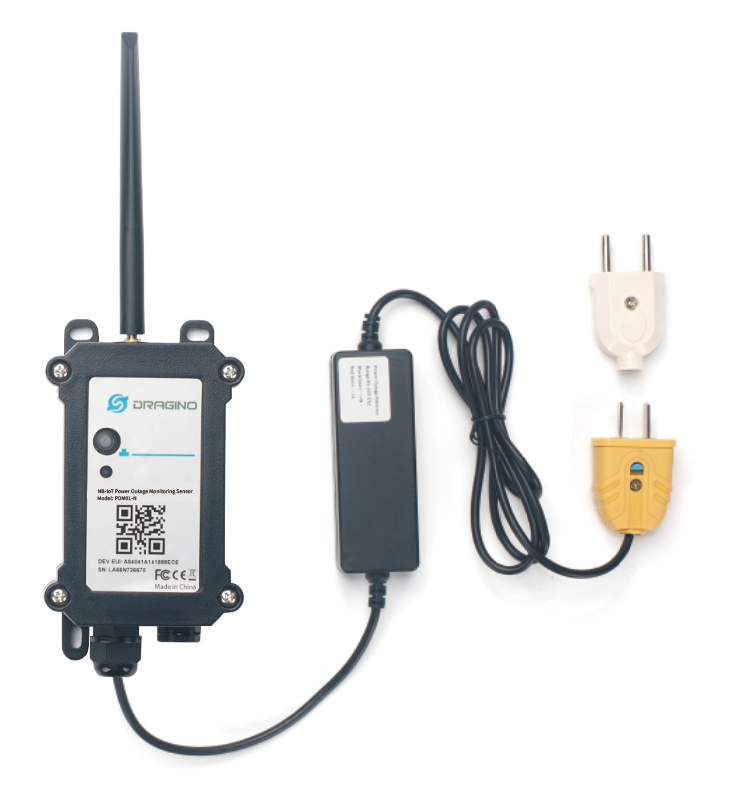
1.1 What is POM01-N NB-IoT Power Outage Monitoring Sensor
The POM01-N integrates NB-IoT wireless module, which sends signals to the cloud platform when triggering alarms or timed reports, and is suitable for remote monitoring scenarios with wide coverage and low power consumption.
The POM01-N adopts optocoupler isolation technology to detect whether the 220V power supply is normal or not, and can set the 180V low voltage trigger threshold to start the alarm logic immediately when the voltage drops abnormally.
The main power supply of POM01-N is directly powered by 220VAC - 5VDC and can seamlessly switch to backup power in the event of a power outage, guaranteeing continuous operation for 30 days.
POM01-N has a wide temperature operating range, and the battery supports cyclic charging and discharging, adapting to complex industrial environments.
POM01-N supports BLE configure and wireless OTA update which make user easy to use.
POM01-N supports different uplink methods include TCP, MQTT, UDP, MQTTs or CoAP for different application requirement. and Support Uplinks to various IoT Servers.
POM01-N has optional built-in SIM card and default IoT server connection version. Which makes it works with simple configuration.
1.2 Features
- NB-IoT Bands: B1/B2/B3/B4/B5/B8/B12/B13/B17/B18/B19/B20/B25/B28/B66/B70/B85 @H-FDD
- Ultra-low power consumption
- Power Outage Monitoring (<17v)
- Low Voltage Monitoring (< 180v)
- Uplink via MQTT, MQTTs, TCP, UDP or CoAP
- Support Bluetooth v5.1 remote configure and update firmware
- Uplink on periodically
- Downlink to change configure
- Back up rechargeable 1000mAh battery
- Nano SIM card slot for NB-IoT SIM
1.3 Specification
Common Characteristics:
- Supply Voltage: 85 ~ 305VAC
- Operating Temperature: -40 ~ 85°C
NB-IoT Spec:
NB-IoT Module: BC660K-GL
Support Bands:
- B1 @H-FDD: 2100MHz
- B2 @H-FDD: 1900MHz
- B3 @H-FDD: 1800MHz
- B4 @H-FDD: 2100MHz
- B5 @H-FDD: 860MHz
- B8 @H-FDD: 900MHz
- B12 @H-FDD: 720MHz
- B13 @H-FDD: 740MHz
- B17 @H-FDD: 730MHz
- B18 @H-FDD: 870MHz
- B19 @H-FDD: 870MHz
- B20 @H-FDD: 790MHz
- B25 @H-FDD: 1900MHz
- B28 @H-FDD: 750MHz
- B66 @H-FDD: 2000MHz
- B70 @H-FDD: 2000MHz
- B85 @H-FDD: 700MHz
Battery:
- Back up rechargeable 1000mAh battery
Power Consumption
- ldle: 4mA
- Transmit: max 40mA
1.4 Applications
- Smart Buildings & Home Automation
- Logistics and Supply Chain Management
- Smart Metering
- Smart Agriculture
- Smart Cities
- Smart Factory
- Electricity Meter
- Line Voltage
1.5 Sleep mode and working mode
**Deep Sleep Mode: **Sensor doesn't have any NB-IoT activate. This mode is used for storage and shipping to save battery life.
Working Mode: In this mode, Sensor will work as NB-IoT Sensor to Join NB-IoT network and send out sensor data to server. Between each sampling/tx/rx periodically, sensor will be in IDLE mode), in IDLE mode, sensor has the same power consumption as Deep Sleep mode.
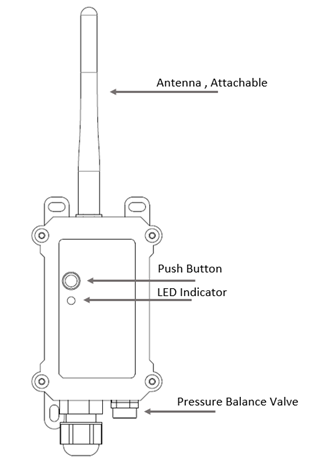
1.6 Button & LEDs
| Behavior on ACT | Function | Action |
|---|---|---|
| Pressing ACT between 1s < time < 3s | Send an uplink | If sensor has already attached to NB-IoT network, sensor will send an uplink packet, blue led will blink once. Meanwhile, BLE module will be active and user can connect via BLE to configure device. |
| Pressing ACT for more than 3s | Active Device | Green led will fast blink 5 times, device will enter OTA mode for 3 seconds. And then start to attach NB-IoT network. Green led will solidly turn on for 5 seconds after joined in network. Once sensor is active, BLE module will be active and user can connect via BLE to configure device, no matter if device attach NB-IoT network or not |
| Fast press ACT 5 times. | Deactivate Device | Red led will solid on for 5 seconds. Means device is in Deep Sleep Mode. |
1.7 BLE connection
POM01-N support BLE remote configure and firmware update.
BLE can be used to configure the parameter of sensor or see the console output from sensor. BLE will be only activate on below case:
- Press button to send an uplink
- Press button to active device.
- Device Power on or reset.
If there is no activity connection on BLE in 60 seconds, sensor will shut down BLE module to enter low power mode.
1.8 Pin Definitions , Switch & SIM Direction
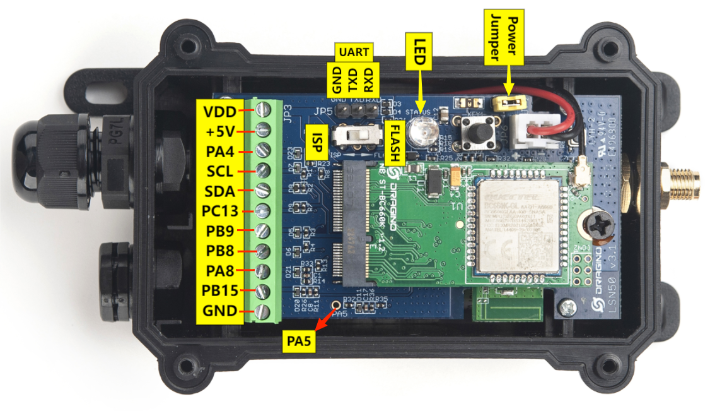
1.8.1 Jumper JP2
Power on Device when put this jumper.
Power off device when take out this jumper
1.8.2 BOOT MODE / SW1
1) ISP: upgrade mode, device won't have any signal in this mode. but ready for upgrade firmware. LED won't work. Firmware won't run.
2) Flash: work mode, device starts to work and send out console output for further debug
1.8.3 Reset Button
Press to reboot the device.
1.8.4 SIM Card Direction
See this link. How to insert SIM Card.
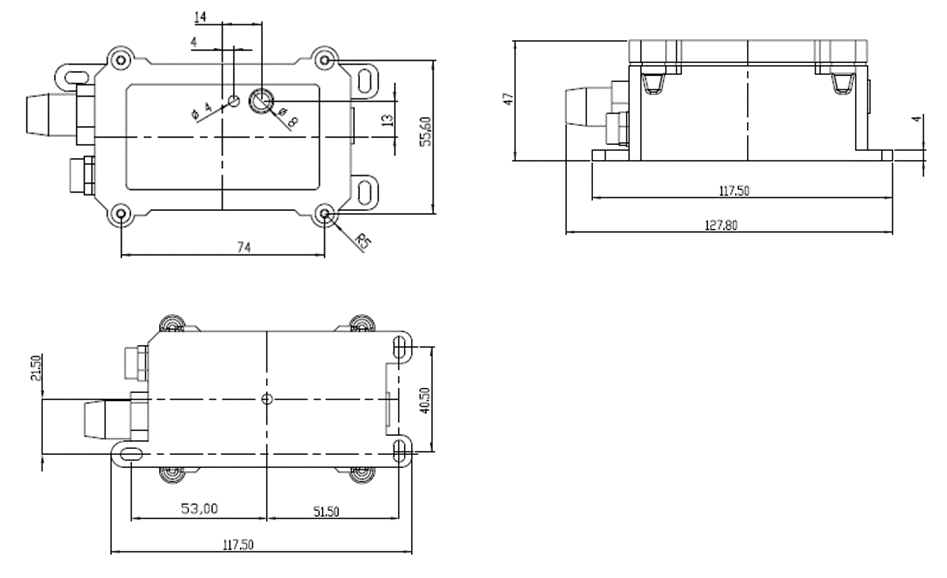
1.9 Mechanical
1.10 Hardware connection
1.10.1 Pins of AC detect module
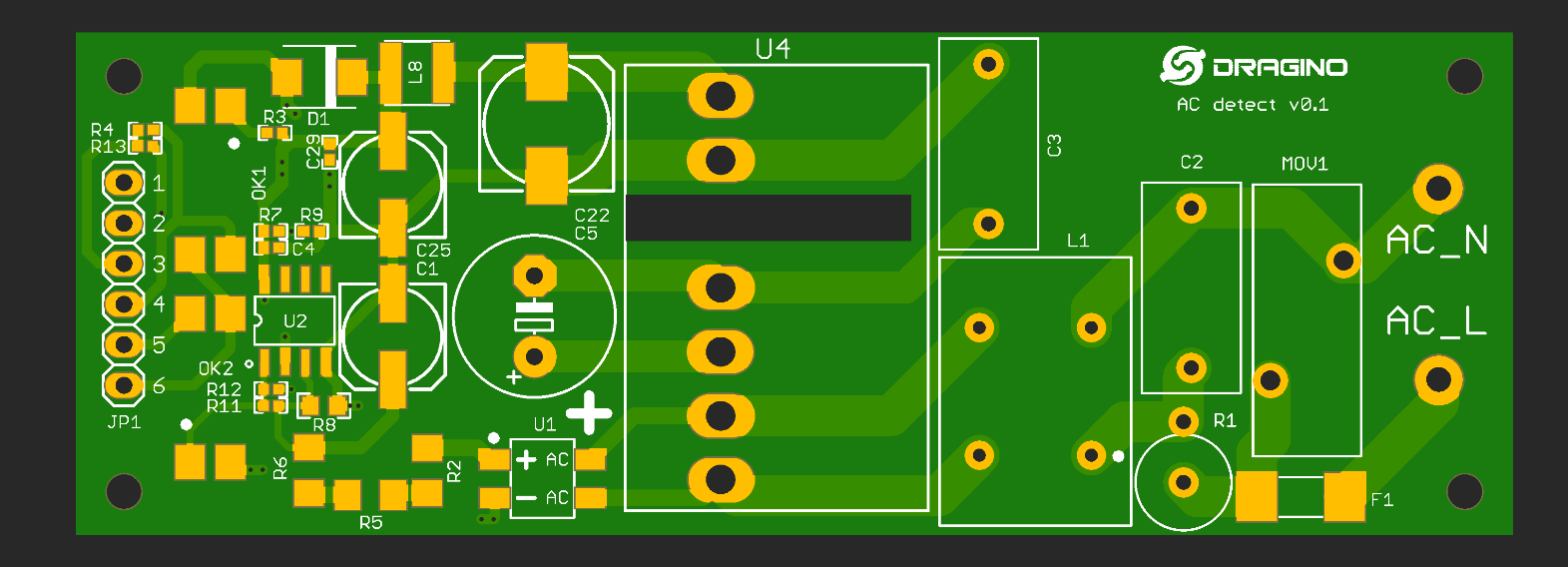
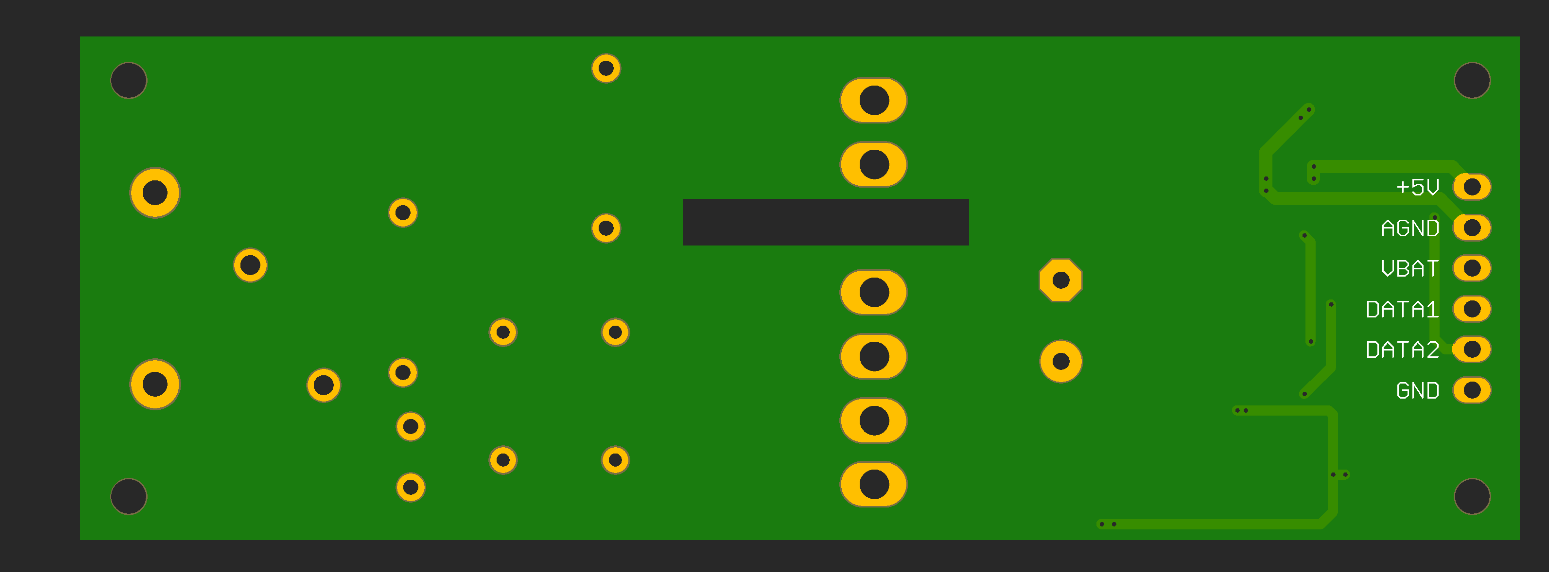
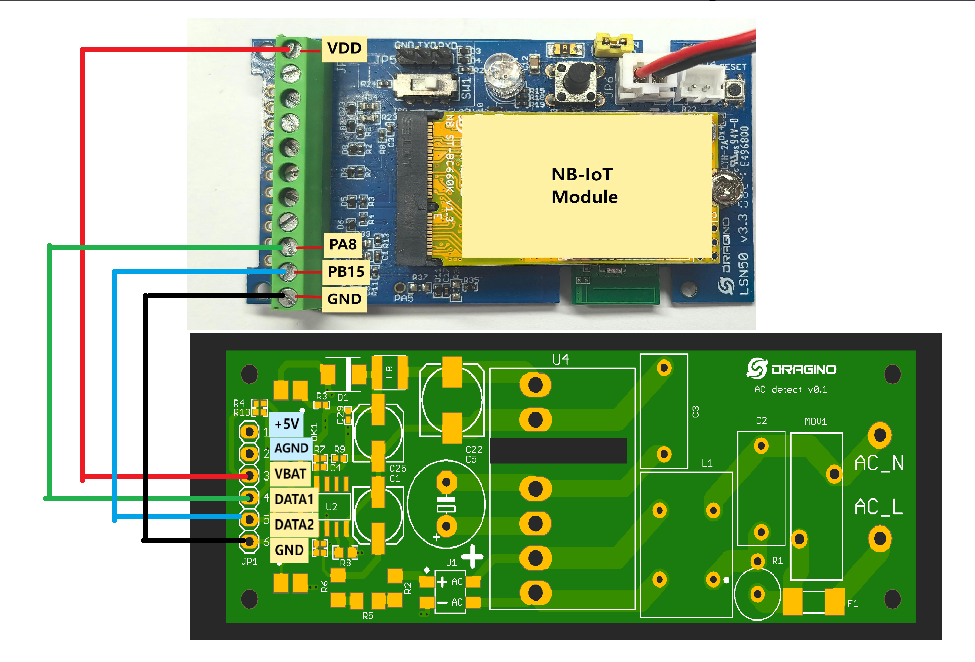
1.10.2 Connection between AC detect module and POM01-N motherboard
- VBAT <---> VDD
- DATA1 <---> PA8 (Tentative as interrupt pin 1)
- DATA2 <---> PB15 (Tentative as interrupt pin 2)
- GND <---> GND
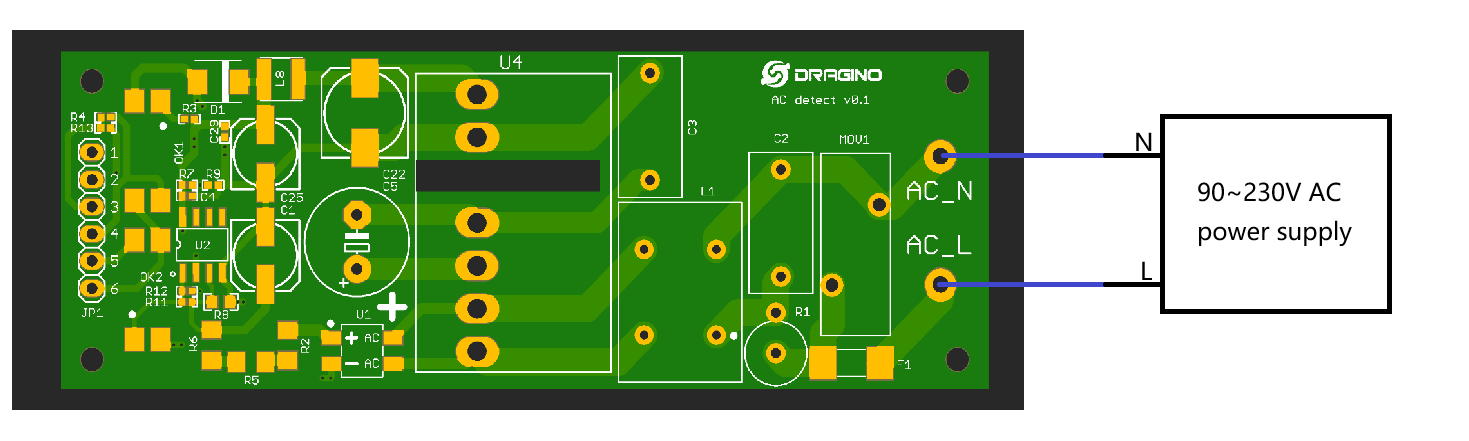
1.10.3 Connection between AC detect module and AC power supply(90 ~230v)
- AC_N <---> AC power supply N
- AC_L <---> AC power supply L
1.11 Voltage detection range
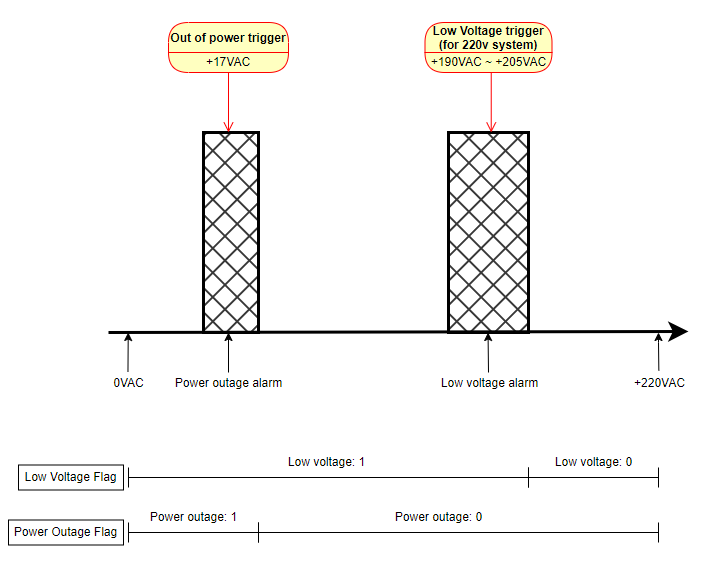
1.11.1 Voltage detection example
1. When the AC voltage rises from 0VAC to 220VAC: power outage = 1 --> 0, low voltage = 1 --> 0, a voltage status change data packet will be sent, as shown in the figure below:
2. When the AC voltage rises from 0VAC to 110VAC: Power outage = 1 --> 0, low voltage = 1 --> 1, a voltage state change data packet will be sent, as shown in the figure below:
3. When the AC voltage rises from 0VAC to above 17VAC but below 190V: Power outage = 1 --> 0, low voltage = 1 --> 1, a voltage status change data packet will be sent, as shown in the figure below:
- When the AC voltage drops from above 17VAC to below 15VAC: Power outage = 0 --> 1, low voltage = 1 --> 1, a voltage status change data packet will be sent, as shown in the figure below:
2. Use POM01-N to communicate with IoT Server
2.1 Send data to IoT server via NB-IoT network
The POM01-N is equipped with a NB-IoT module, the pre-loaded firmware in POM01-N will get environment data from sensors and send the value to local NB-IoT network via the NB-IoT module. The NB-IoT network will forward this value to IoT server via the protocol defined by POM01-N.
Below shows the network structure:
To be updated...
There are two version: -GE and -1T version of POM01-N.
GE Version: This version doesn't include SIM card or point to any IoT server. User needs to use AT Commands to configure below two steps to set POM01-N send data to IoT server.
-
Install NB-IoT SIM card and configure APN. See instruction of Attach Network.
-
Set up sensor to point to IoT Server. See instruction of Configure to Connect Different Servers.
Below shows result of different server as a glance.
| Servers | Dash Board | Comments |
|---|---|---|
| Node-Red | 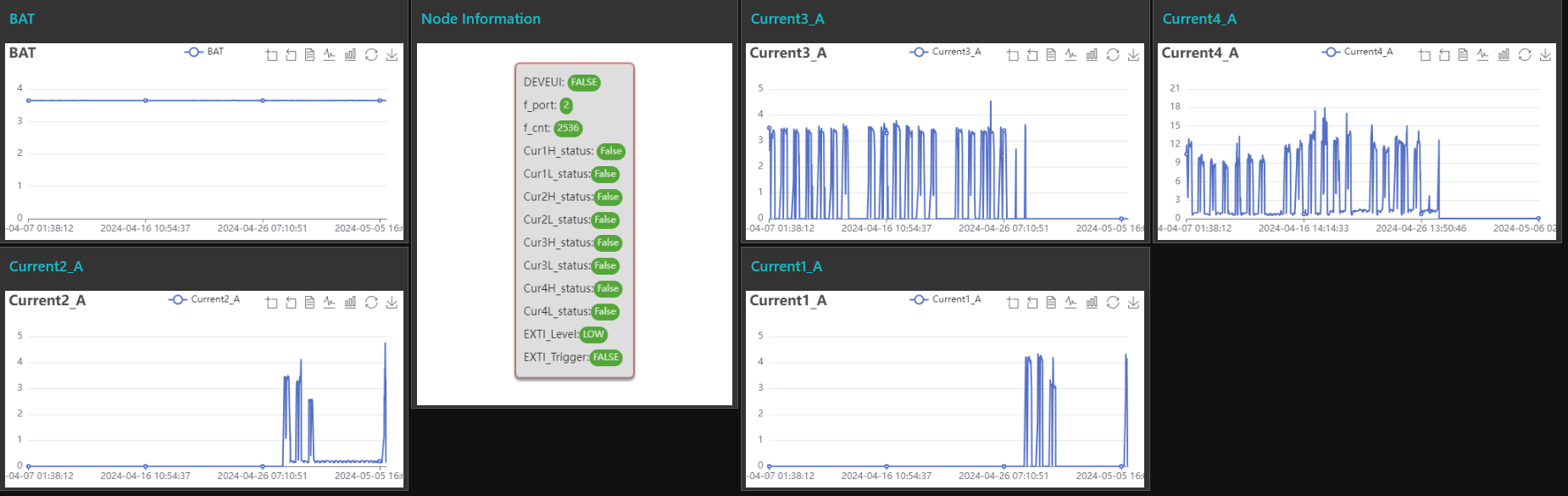 | |
| DataCake | 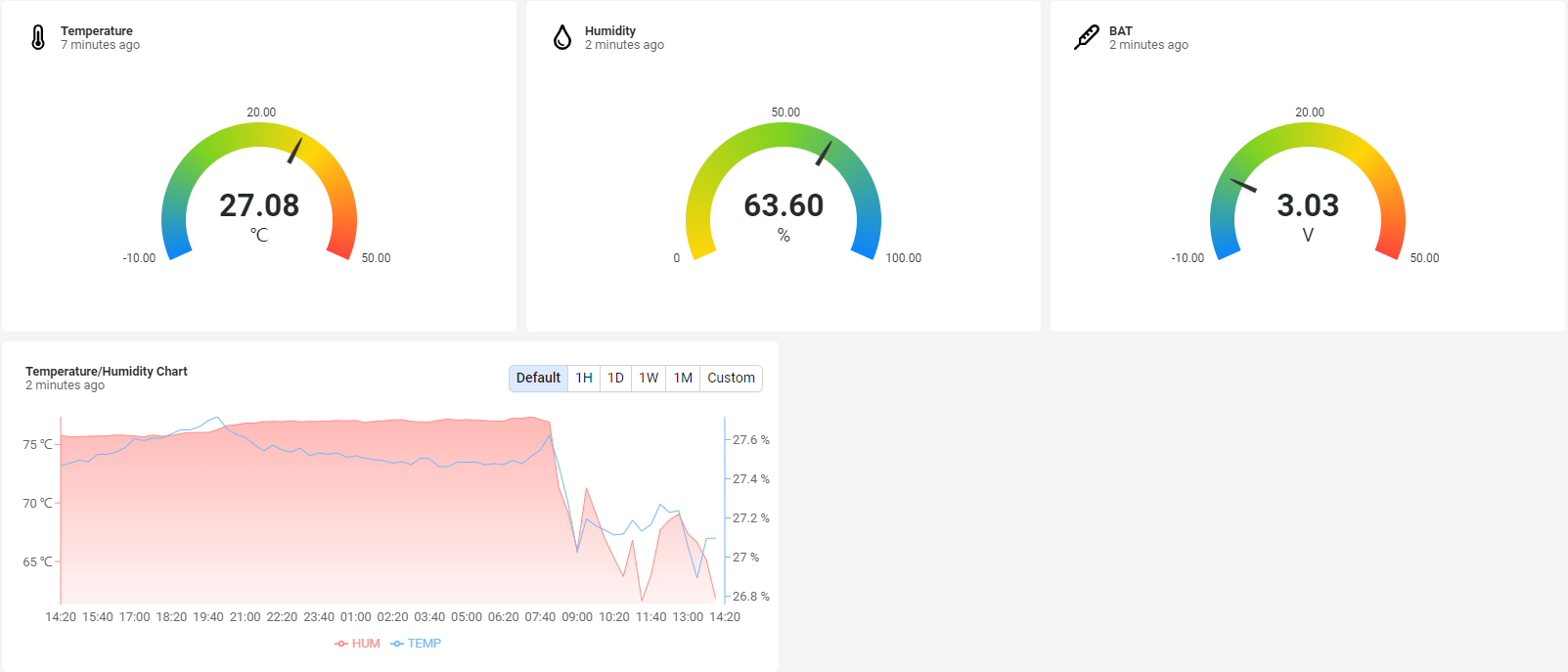 | |
| Tago.IO | 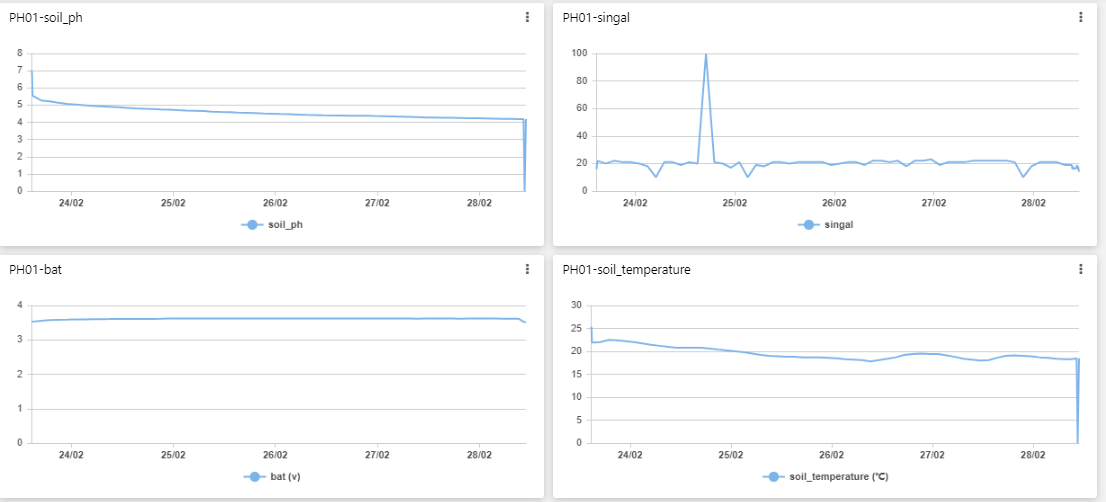 | |
| General UDP | Raw Payload. Need Developer to design Dash Board | |
| General MQTT | Raw Payload. Need Developer to design Dash Board | |
| ThingSpeak | 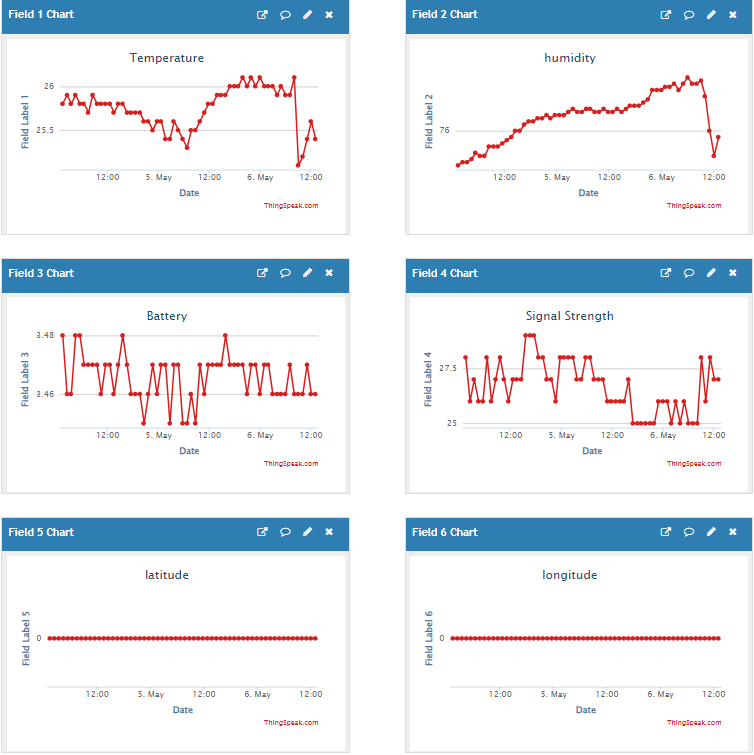 | |
| ThingsBoard | 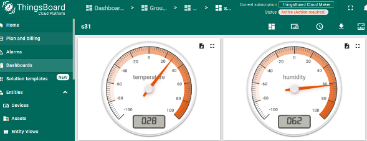 |
1T Version: This version has 1NCE SIM card pre-installed and configure to send value to ThingsEye. User Just need to select the sensor type in ThingsEyeand Activate POM01-N and user will be able to see data in ThingsEye. See here for ThingsEye Config Instruction.
2.2 Payload Types
To meet different server requirement, POM01-N supports different payload type.
Includes:
-
General JSON format payload. (Type=5)
-
HEX format Payload. (Type=0)
-
ThingSpeak Format. (Type=1)
-
ThingsBoard Format. (Type=3)
User can specify the payload type when choose the connection protocol. Example:
AT+PRO=1,0 // Use COAP Connection & hex Payload
AT+PRO=1,5 // Use COAP Connection & Json Payload
AT+PRO=2,0 // Use UDP Connection & hex Payload
AT+PRO=2,5 // Use UDP Connection & Json Payload
AT+PRO=3,0 // Use MQTT Connection & hex Payload
**AT+PRO=3,5 ** // Use MQTT Connection & Json Payload
AT+PRO=4,0 // Use TCP Connection & hex Payload
**AT+PRO=4,5 ** // Use TCP Connection & Json Payload
2.2.1 General Json Format(Type=5)
This is the General Json Format. As below:
{"IMEI":"863663062798914","IMSI":"460087023300073","Model":"POM01-NB","battery":3.33,"signal":18,"mod":1,"power_outage":1,"low_voltage":1,"time":"2025/10/27 03:03:53","1":[1,1,"2025/10/26 18:14:24"],"2":[1,1,"2025/10/26 18:13:24"],"3":[1,1,"2025/10/26 18:12:24"],"4":[1,1,"2025/10/26 18:11:24"],"5":[1,1,"2025/10/26 18:10:24"],"6":[1,1,"2025/10/26 18:09:24"],"7":[1,1,"2025/10/26 18:08:24"],"8":[1,1,"2025/10/26 18:07:24"]}
Example:
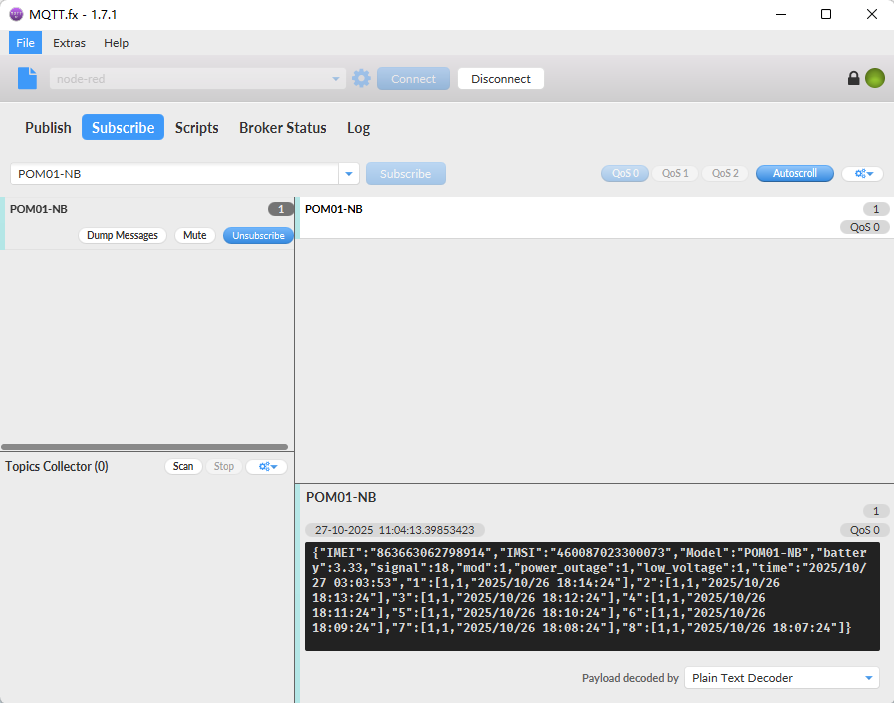
Note:
-
power_outage, low_voltage, Battery, Signal, mod & time are the value at uplink time.
-
Json entry 1 ~ 8 are the last 1 ~ 8 sampling data as specify by **AT+CLOCKLOG=1,65535,15,8 ** Command. Each entry includes (from left to right): power_outage, low_voltage, Sampling time.
2.2.2 HEX format Payload(Type=0)
This is the HEX Format. As below:
f863663062798914f46008702330007343640d041201010168fee3ec010168fee371010168fee335010168fee2f9010168fee2bd010168fee281010168fee245010168fee209010168fee1cd
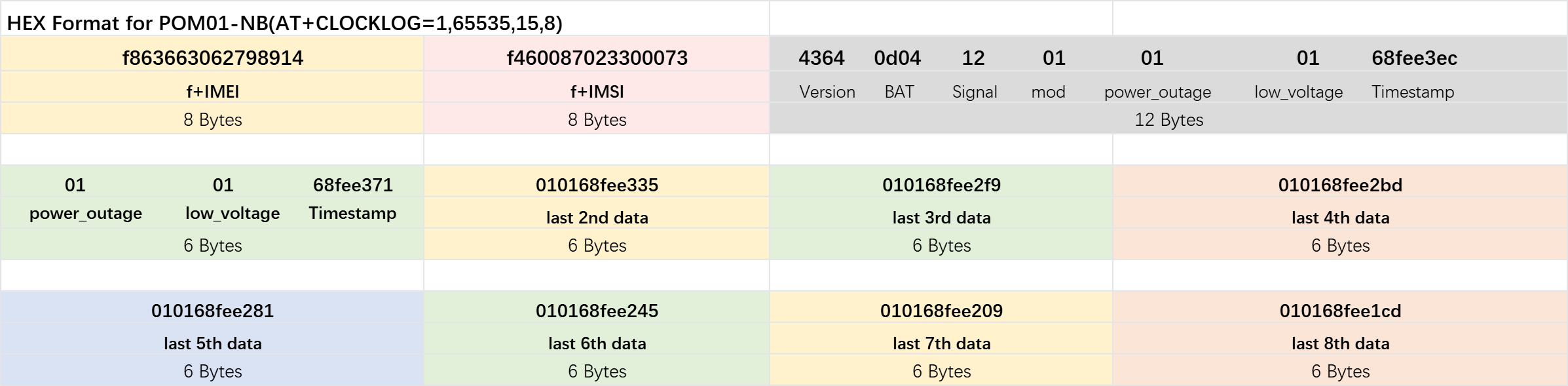
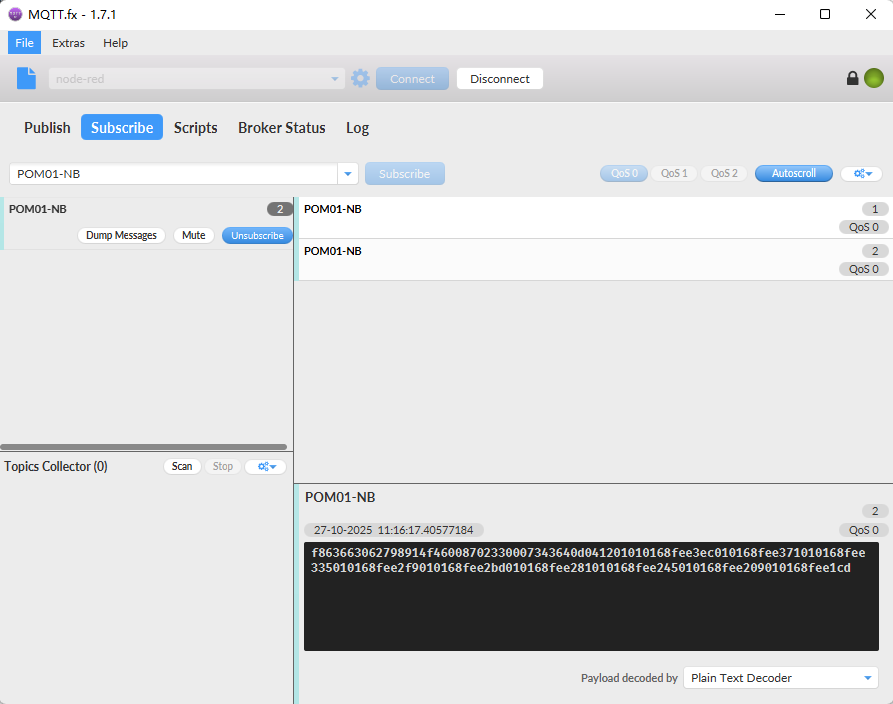
Version:
These bytes include the hardware and software version.
Higher byte: Specify Sensor Model: 0x43 for POM01-N
Lower byte: Specify the software version: 0x64=100, means firmware version 1.0.0
BAT (Battery Info):
Ex1: 0x0d04 = 3332mV
Signal Strength:
NB-IoT Network signal Strength.
Ex1: 0x12 = 18
0 -113dBm or less
1 -111dBm
2...30 -109dBm... -53dBm
31 -51dBm or greater
99 Not known or not detectable
**power_outage: **
When the voltage drops from above 17V to below 17V, the state changes and a data packet is uploaded once. When the voltage rises from below 17V to above 17V, the state changes and a data packet is uploaded once.
Ex1: 0x00 Indicates voltage is greater than 17 volts (low level)
**Ex2: **0x01 Indicates voltage is below 17 volts (high level)
** low_voltage: **
When the voltage drops from above 205V to below 190V, the status changes and a data packet is uploaded once. When the voltage rises from below 190V to above 205V, the status changes and a data packet is uploaded once.
Ex1: 0x00 Indicates voltage is greater than 180 volts (low level)
**Ex2: **0x01 Indicates voltage is below 180 volts (high level)
**TimeStamp: **
Unit TimeStamp Example: 68fee3ec(H) = 1761534956(D)
Put the decimal value into this link(https://www.epochconverter.com/) to get the time.
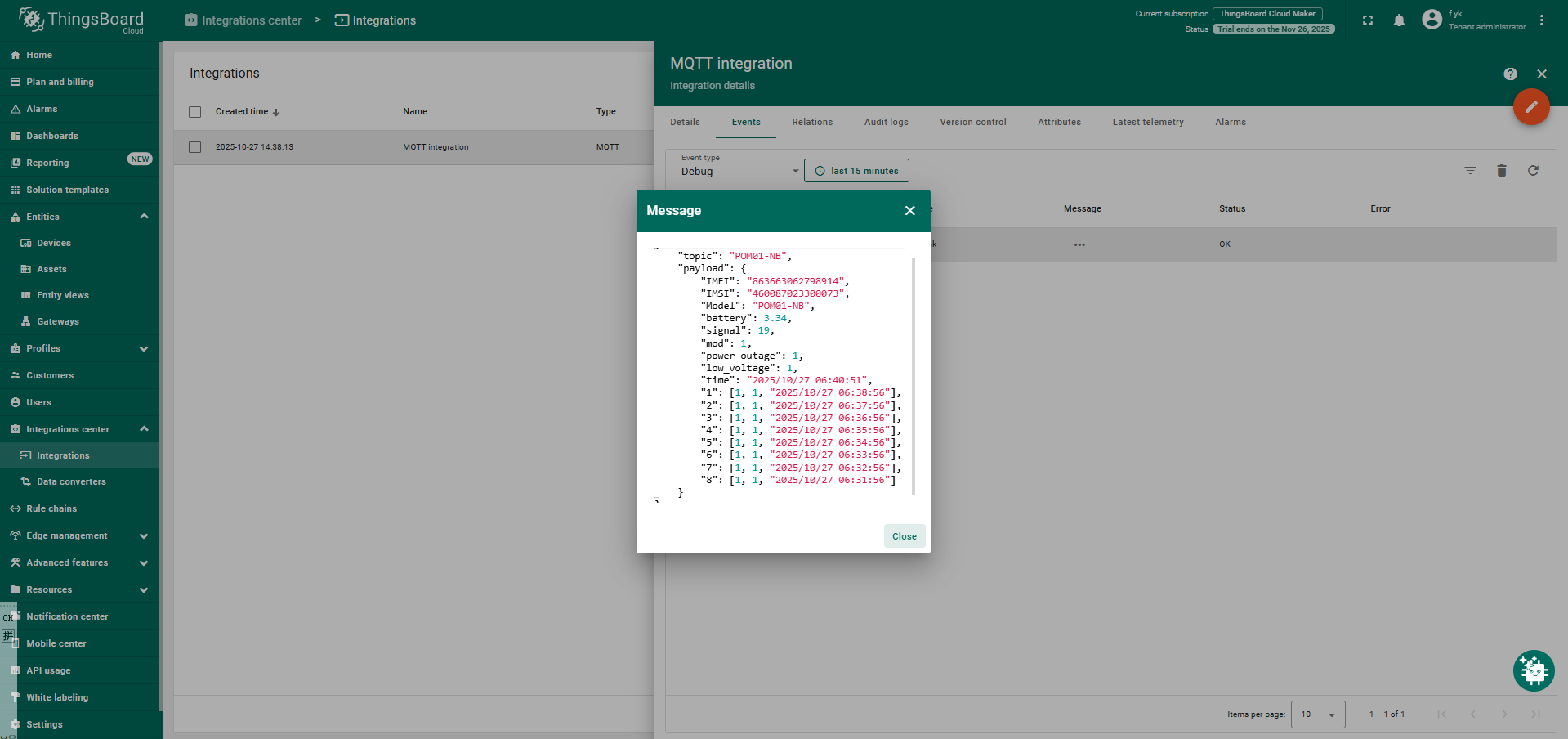
2.2.3 ThingsBoard Payload(Type=3)
Type3 payload special design for ThingsBoard, it will also configure other default server to ThingsBoard.
{ "topic": "POM01-NB", "payload": { "IMEI": "863663062798914", "IMSI": "460087023300073", "Model": "POM01-NB", "battery": 3.34, "signal": 19, "mod": 1, "power_outage": 1, "low_voltage": 1, "time": "2025/10/27 06:40:51", "1": [1, 1, "2025/10/27 06:38:56"], "2": [1, 1, "2025/10/27 06:37:56"], "3": [1, 1, "2025/10/27 06:36:56"], "4": [1, 1, "2025/10/27 06:35:56"], "5": [1, 1, "2025/10/27 06:34:56"], "6": [1, 1, "2025/10/27 06:33:56"], "7": [1, 1, "2025/10/27 06:32:56"], "8": [1, 1, "2025/10/27 06:31:56"] } }
2.2.4 ThingSpeak Payload(Type=1)
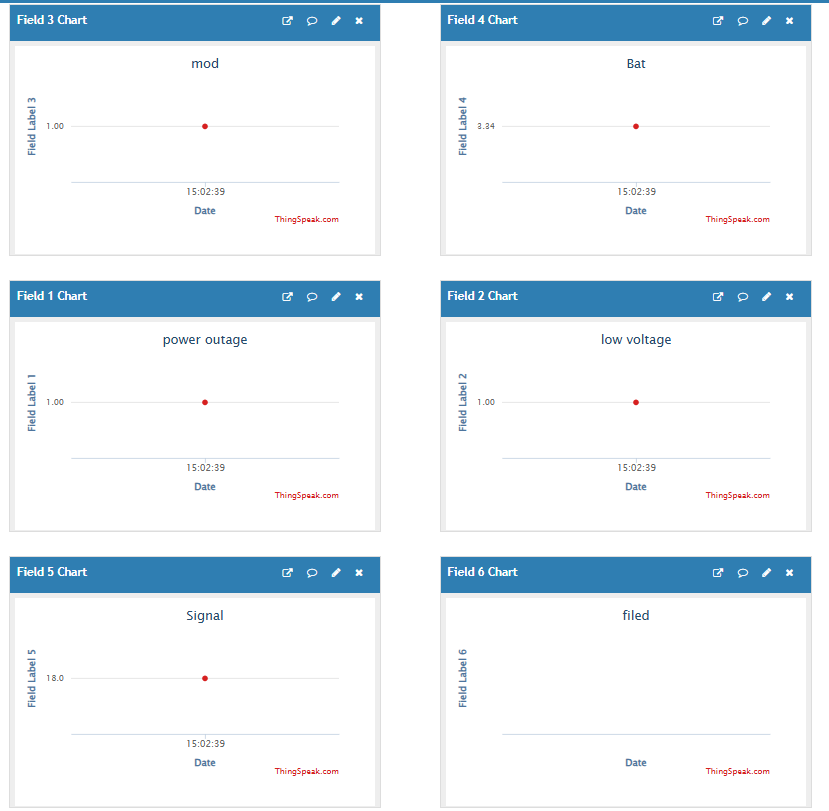
This payload meets ThingSpeak platform requirement. It includes only four fields. Form 1~5 are:
mod, Battery, power outage, low voltage & Signal. This payload type only valid for ThingsSpeak Platform
As below:
field1=mod&field2=BatV&field3=power outage&field4=low voltage&field5=signal
2.3 Test Uplink and Change Update Interval
By default, Sensor will send uplinks every 2 hours
User can use below commands to change the uplink interval.
AT Command: AT+TDC
Example: AT+TDC=7200 // Set Update Interval to 7200 seconds
Downlink Command: 0x01
Format: Command Code (0x01) followed by 3 bytes.
Example: 12 hours= 43200 seconds 43200(D)=0xA8C0(H)
Downlink Payload: `01 00 A8 C0` // AT+TDC=43200, Set Update Interval to 12 hours.
Note: User can also push the button for more than 1 second to activate an uplink.
2.4 Trggier an uplink by external interrupt
POM01-N has an external trigger interrupt function. Users can use the PB15 and PA8 pin to trigger the upload of data packets.
Note:Parameter 1 controls the trigger mode of PA8, and parameter 2 controls the trigger mode of PB15.
AT command:
-
**AT+INTMOD ** // Set the trigger interrupt mode
-
**AT+INTMOD=0,0 ** // Disable Interrupt
-
**AT+INTMOD=1,1 ** // Set PA8 and PB15 to both rising and falling edge triggers
-
**AT+INTMOD=2,2 ** // Set PA8 and PB15 to both falling edge
-
**AT+INTMOD=3,3 ** // Set PA8 and PB15 to both rising edge
Downlink command: 0x06
Format: Command Code (0x06) followed by 2 byte.
Ex1: Downlink payload: 0x060000 // AT+INTMOD=0,0
Ex2: Downlink payload: **0x060101 ** // AT+INTMOD=1,1
2.5 Clock logging
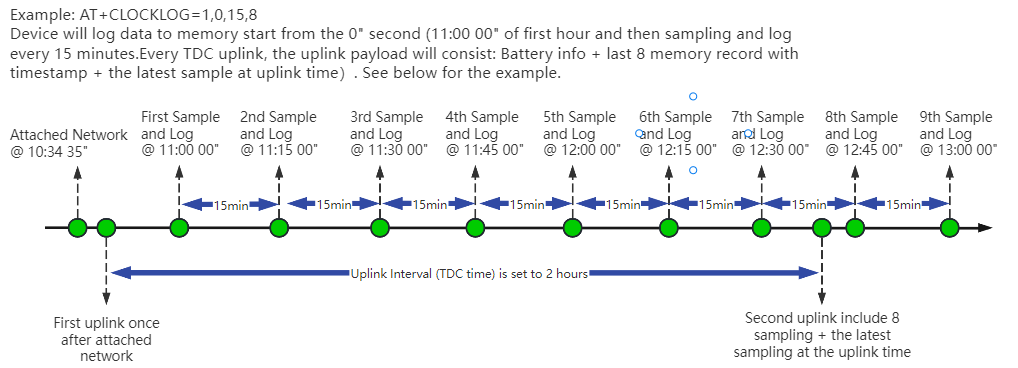
Sometimes when we deploy lots of end nodes in field. We want all sensors sample data at the same time, and upload these data together for analyze. In such case, we can use clock loging feature.
We can use this command to set the start time of data recording and the time interval to meet the requirements of the specific collection time of data.
- AT command: AT+CLOCKLOG=a,b,c,d
a: 0: Disable Clock logging. ** 1: **Enable Clock Logging
**b: **Specify First sampling start second: range **(0 ~ 3599, 65535) ** // **Note: **If parameter b is set to 65535, the log period starts after the node accesses the network and sends packets.
**c: **Specify the sampling interval: range (0 ~ 255 minutes)
**d: **How many entries should be uplink on every TDC (max 32)
Note: To disable clock recording, set the following parameters: AT+CLOCKLOG=1,65535,0,0
Example:
AT+CLOCKLOG=1,65535,1,5
After the node sends the first packet, data is recorded to the memory at intervals of 1 minute. For each TDC uplink, the uplink load will include: battery information + the last 5 memory records (payload + timestamp).
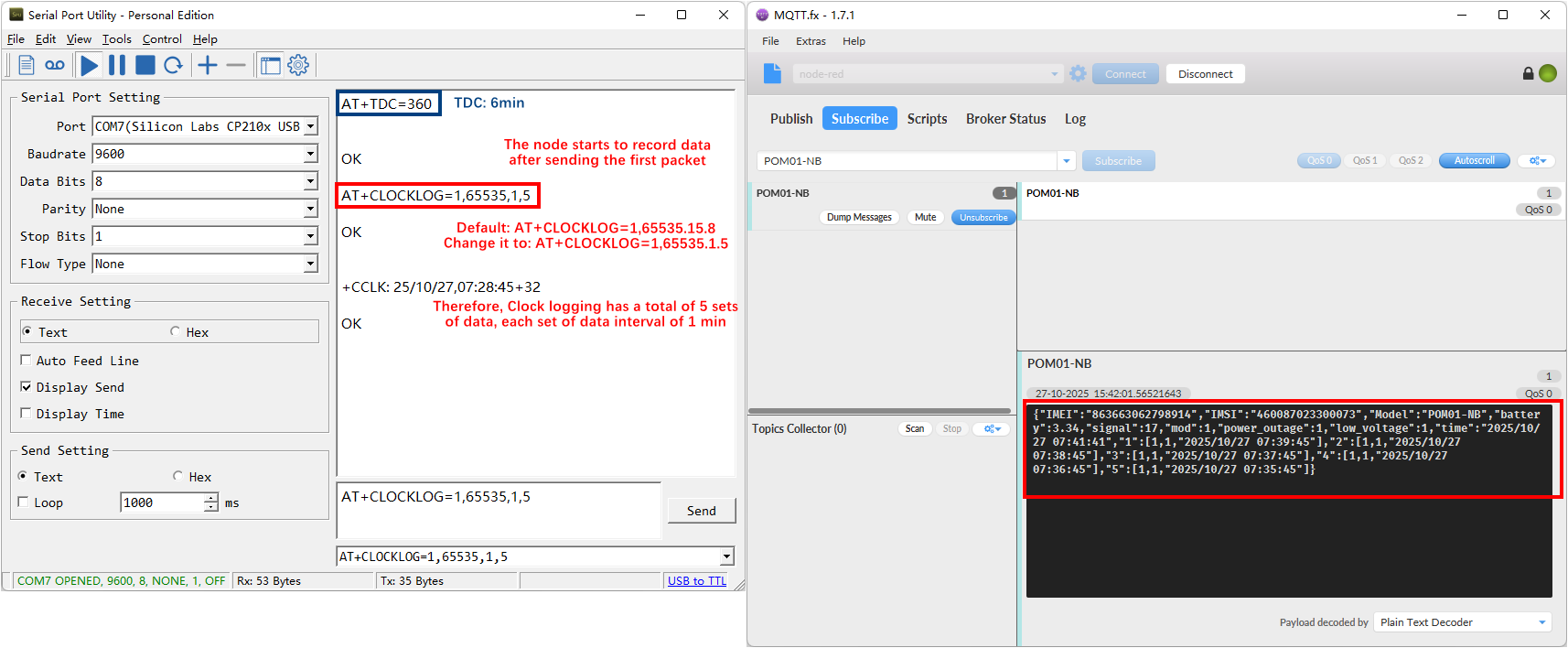
Note: Users need to synchronize the server time before configuring this command. If the server time is not synchronized before this command is configured, the command takes effect only after the node is reset.
- Downlink command: 0x0A
Format: Command Code (0x0A) followed by 5 bytes.
- Example 1: Downlink Payload:** 0A01FFFF0F08** // Set SHT record time: AT+CLOCKLOG=1,65535,15,8
- Example 1: Downlink Payload:** 0A0104B00F08** // Set SHT record time: AT+CLOCKLOG=1,1200,15,8
Note: When entering the downlink payload, there must be no Spaces between bytes.
2.6 Example Query saved historical records
- AT command: AT+CDP
This command can be used to search the saved history, recording up to 32 groups of data, each group of historical data contains a maximum of 100 bytes.
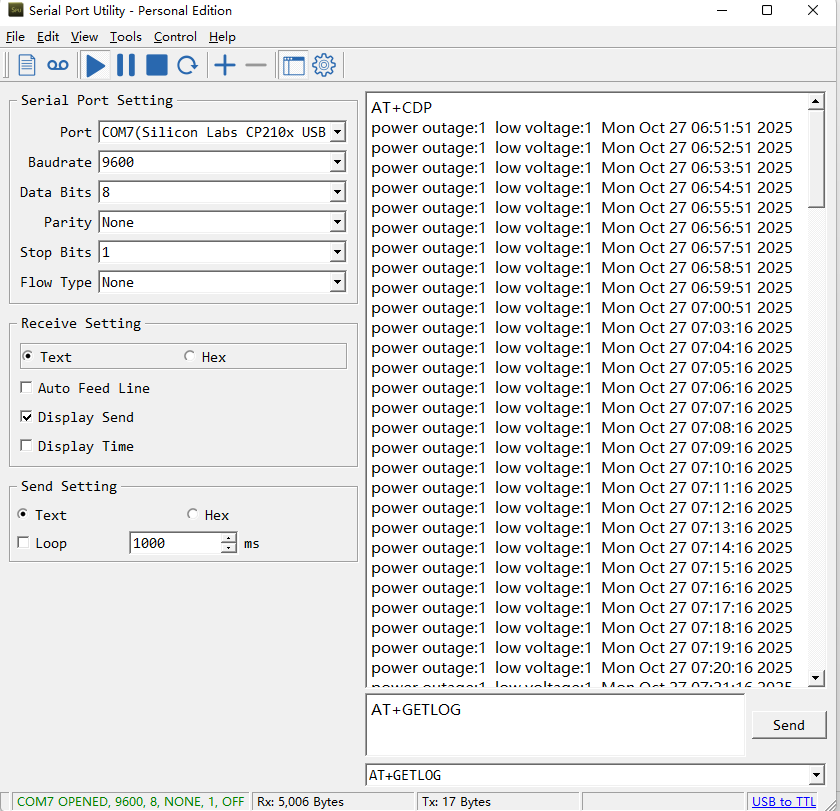
2.7 Uplink log query
- AT command: AT+GETLOG
This command can be used to query upstream logs of data packets.
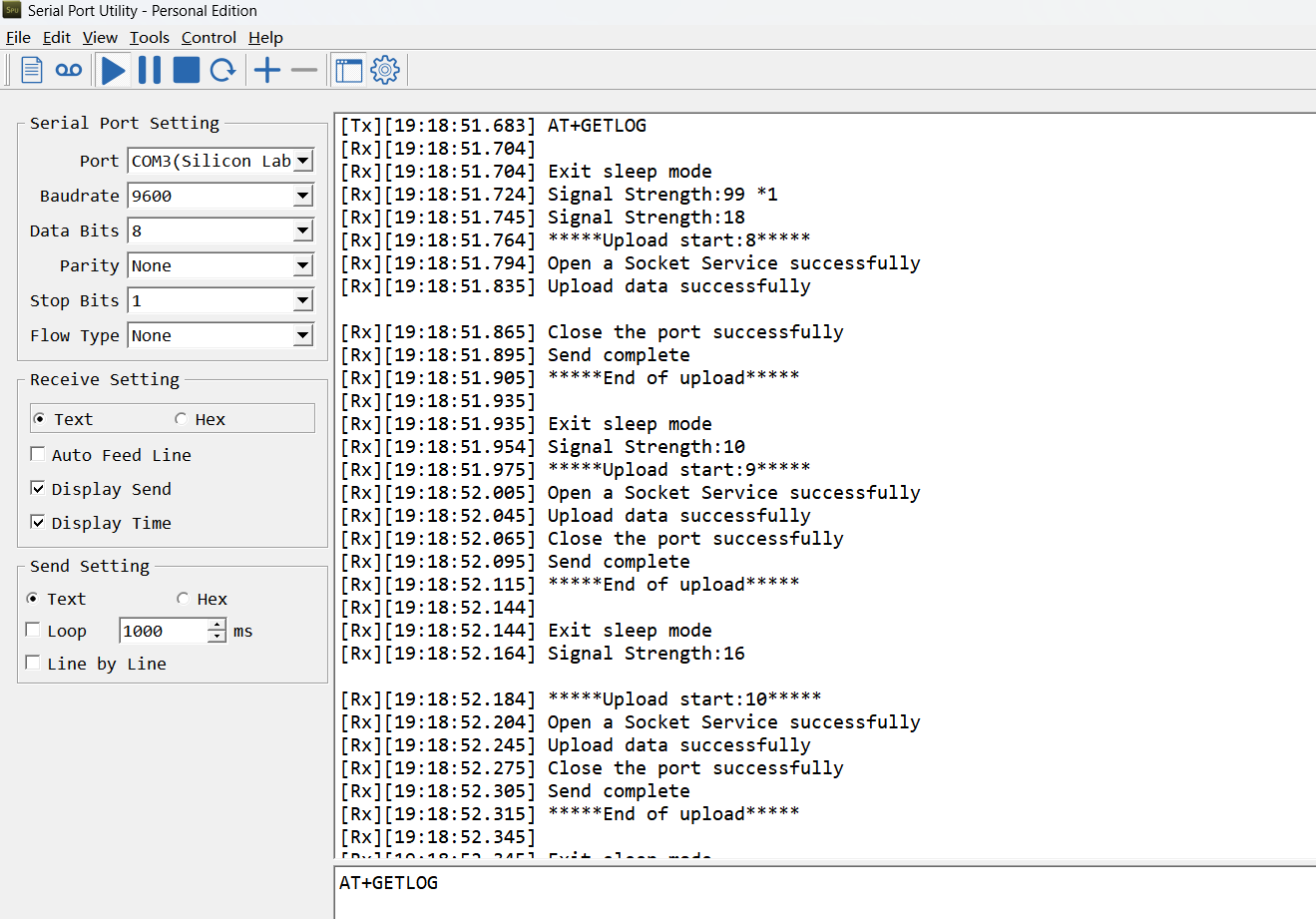
2.8 Set the QoS level
This command is used to set the QoS level of MQTT.
AT command:
- **AT+MQOS=xx **// 0~2
Downlink command: 0x07
Format: Command Code (0x07) followed by 1 byte.
Ex1: Downlink payload: 0x0700 // AT+MQOS=0
Ex2: Downlink payload: 0x0701 // AT+MQOS=1
2.9 Set CoAP option
This command sets the connection parameters of the COAP.
AT command:
- AT+URI1 // CoAP option name, CoAP option length, "CoAP option value"
- AT+URI2 // CoAP option name, CoAP option length, "CoAP option value"
- AT+URI3 // CoAP option name, CoAP option length, "CoAP option value"
- AT+URI4 // CoAP option name, CoAP option length, "CoAP option value"
Example:
- AT+URI1=11,38,"i/faaa241f-af4a-b780-4468-c671bb574858"
2.10 Set the downlink debugging mode
Feature: Enable or disable downlink debugging mode. (Since TE platform update, the platform version selection is no longer needed; only downlink debugging can be toggled.)
AT command: AT+DOWNTE
| Command Example | Function/Parameters | Response/Explanation |
|---|---|---|
| AT+DOWNTE=? | Get current Settings | 0,0 (default) OK |
| AT+DOWNTE=0,a | a: Enable/Disable downlink debugging | 0: Disable downlink debugging mode. 1: Enable downlink debugging mode (users can view original downlink messages). |
(Note: The first parameter is fixed to 0 and only the second parameter is configurable.)
Example:
- AT+DOWNTE=0,1 → Enable downlink debugging mode.
- AT+DOWNTE=0,0 → Disable downlink debugging mode.
**Downlink Command: **
No downlink commands for feature
2.11 Domain name resolution settings
Feature: Set dynamic domain name resolution IP.
AT command: AT+BKDNS
| Command Example | Function/Parameters | Response/Explanation |
|---|---|---|
| AT+BKDNS=? | Get current Settings | 1,0,NULL (default) OK |
AT+BKDNS=a,b,c | a: Enable/Disable dynamic domain name resolution. | 1: Disable dynamic domain name update. The ip address will be saved after the domain name is resolved, if the next domain name resolution fails, the last saved ip address will be used. 2: Enable dynamic domain name update. The ip address will be saved after domain name resolution, if the next domain name resolution fails, the last saved ip address will be used, and the domain name resolution will be updated regularly according to the time set by the customer. |
| b: Set the time to update the domain name resolution at regular intervals. | Unit: hour | |
| c: Set the IP address manually. | The format is the same as AT+SERVADDR. If domain name resolution fails, this ip address will be used directly, if domain name resolution succeeds, parameter c will be updated to the successfully resolved IP address. |
Example:
- AT+BKDNS=1,0 // Dynamic domain name resolution is disabled.
- AT+BKDNS=2,1 // The dynamic domain name resolution function is enabled and the automatic update time is set to 1 hour.
- AT+BKDNS=2,4,3.69.98.183,1883 // The dynamic domain name resolution function is enabled and the automatic update time is set to 4 hour, and manually set the ip address, if the domain name failed to resolve, it will directly use this ip to communicate. When the next domain name resolution is successful, it will be updated to the ip address of the successful resolution.
**Downlink Command: **
No downlink commands for feature
3. Configure POM01-N
3.1 Configure Methods
POM01-N supports below configure method:
-
AT Command via Bluetooth Connection (Recommended): BLE Configure Instruction.
-
AT Command via UART Connection : See UART Connection.
3.2 Serial Access Password
After the Bluetooth or UART connection is successful, use the Serial Access Password to enter the AT command window.
The label on the box of the node will print the initial password: AT+PIN=xxxxxx, and directly use the six-digit password to access the AT instruction window.
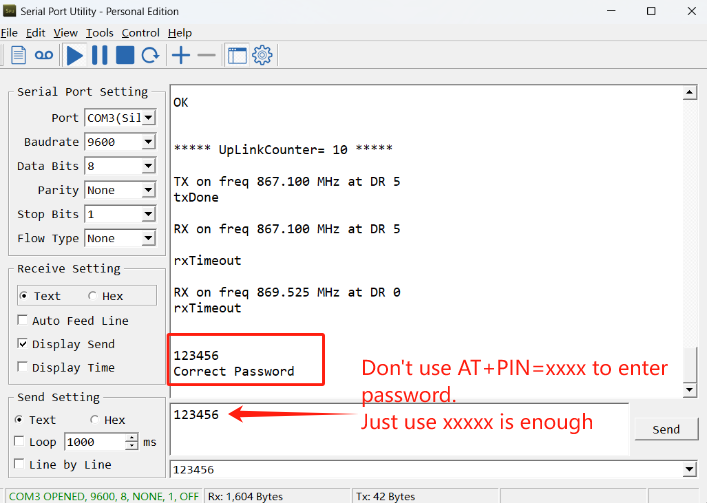
If you need to change the password, use AT+PWORD=xxxxxx (6 characters), -CB nodes only support lowercase letters.
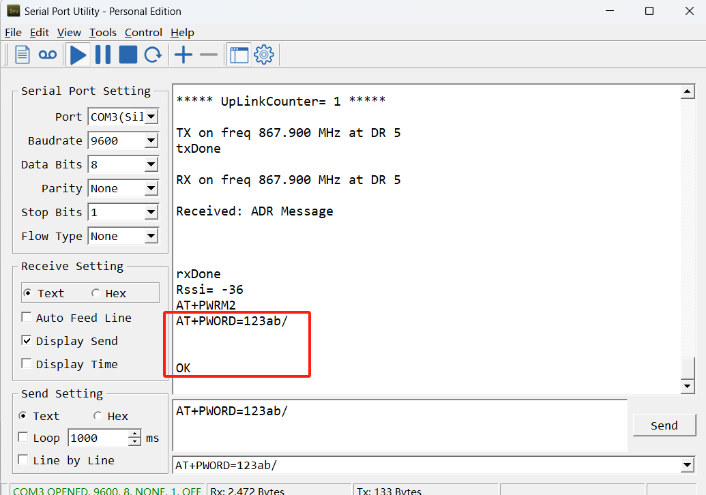
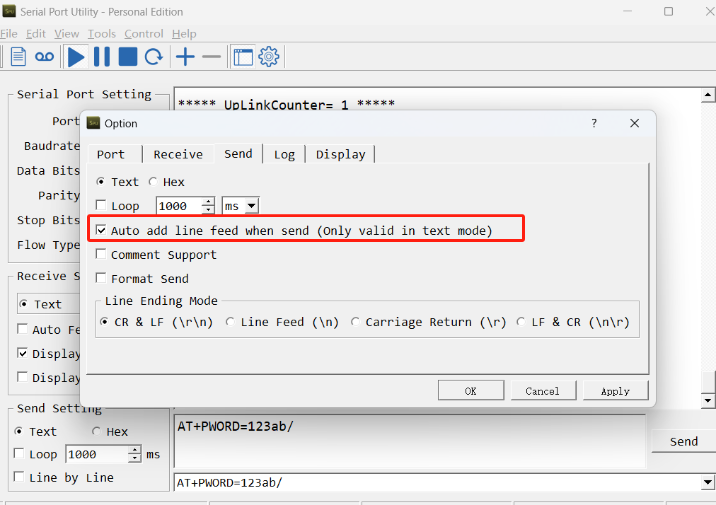
Note: After entering the command, you need to add a line break, and you can also set automatic line breaks in the Bluetooth tool or UART connection tool.
3.3 AT Commands Set
AT+<CMD>? : Help on <CMD>
AT+<CMD> : Run <CMD>
AT+<CMD>=<value> : Set the value
AT+<CMD>=? : Get the value
AT+MODEL : Get module information
ATZ : Trig a reset of the MCU
AT+CFGMOD : Working mode selection
AT+DEUI : Get or set the Device ID
AT+PWORD : Get or set the System password
AT+FDR1 : Reset parameters to factory default values except for passwords
AT+FDR : Reset Parameters to Factory Default
AT+CFG : Print all settings
AT+SERVADDR: Get or Set the Server address
AT+TDC : Get or set the application data transmission interval in s
AT+INTMOD : Get or Set the trigger interrupt mode (0:input,1:falling or rising,2:falling,3:rising)
AT+APN : Get or set the APN
AT+5VT : Get or Set extend the time of 5V power
AT+PRO : Get or Set usage agreement (1:COAP,2:UDP,3:MQTT,4:TCP)
AT+RXDL : Get or Set the receiving time
AT+DNSCFG : Get or Set DNS Server
AT+CSQTIME : Get or Set the time to join the network
AT+BKDNS : Get or Set dynamic domain name resolution IP
AT+DOWNTE: Get or set the conversion between the standard version and 1T version downlinks
AT+SLEEP : Get or Set the sleep mode
AT+CLOCKLOG: Get or set SHT record time
MQTT Management
AT+CLIENT : Get or Set the MQTT clientID
AT+UNAME : Get or Set the MQTT Username
AT+PWD : Get or Set the MQTT password
AT+PUBTOPIC: Get or set MQTT publishing topic
AT+SUBTOPIC: Get or set MQTT subscription topic
AT+TLSMOD : Get or Set the TLS mode
AT+MQOS : Set the QoS level of MQTT
Information
AT+CDP : Read or Clear cached data
AT+LDATA : Get the last upload data
AT+GETSENSORVALUE : Returns the current sensor measurement
AT+GETLOG : Print serial port logs
COAP Management
AT+URI1: Get or set CoAP option 1
AT+URI2: Get or set CoAP option 2
AT+URI3: Get or set CoAP option 3
AT+URI4: Get or set CoAP option 4
4. Battery & Power Consumption
Main Process Unit POM01-N is powered by both external power source and internal 1000mAh rechargeable battery. If external power source is off, POM01-N still runs and can send periodically uplinks
Battery Info & Power Consumption Analyze .
5. Firmware update
User can change device firmware to:
-
Update with new features.
-
Fix bugs.
Firmware and changelog can be downloaded from : **Firmware download link **(To be updated...)
Methods to Update Firmware:
-
(Recommended way) OTA firmware update via BLE: Instruction.
-
Update through UART TTL interface : Instruction.
6. FAQ
6.1 How can I access the BC660K-GL AT Commands?
User can access to BC660K-GL directly and send AT Commands.
6.2 Why is there no LED response when I press the button on the solar panel model?
If the LED does not light up when you press the button, it may be because the battery has entered protection mode.
Solution: To reactivate the battery, simply expose the solar panel to direct sunlight. For more details, please refer to: Battery Protection State (Apply to Solar Panel + Li-ion battery)
7. Order Info
Part Number: POM01-N-XX
XX:
-
**GE: **General version ( Exclude SIM card)
-
1T: with 1NCE * 10 years 500MB SIM card and Pre-configure to ThingsEye server
8. Packing Info
Package Includes:
- POM01-N NB-IoT Power Outage Monitoring Sensor x 1
Dimension and weight:
- Device Size: cm
- Device Weight: g
- Package Size / pcs : cm
- Weight / pcs : g
9. Support
- Support is provided Monday to Friday, from 09:00 to 18:00 GMT+8. Due to different timezones we cannot offer live support. However, your questions will be answered as soon as possible in the before-mentioned schedule.
- Provide as much information as possible regarding your enquiry (product models, accurately describe your problem and steps to replicate it etc) and send a mail to support@dragino.com.
0