How to calculate battery life of Dragino sensors
1. ER26500 + SPC1520 Battery Pack
1.1 Battery Info
ER26500 + SPC1520 battery pack is un-rechargeable Li-SOCl2 battery with 8500mAh and low discharge rate targeting for 8~10 years use. This type of battery is commonly used in IoT target for long-term running, such as water meter. Dragino outdoor sensor models use this type of battery widely.
1.2 Battery Document
The battery related documents as below:
Connector Type:
1.3 When and how to Replace Battery
The discharge curve of ER26500 is not linear so can't simply use percentage to show the battery level. Below is the battery performance.
If we see the battery lower than 2.7v, it is time to replace battery.
Any battery with range 2.7 ~ 3.6v can be a replacement. We recommend using Li-SOCl2 Battery. It is suggest to add SPC1520 super capacitor with the ER26500 battery,The SPC can enlarge the battery life for high frequency use (update period below 5 minutes). If user can't find such capacitor, he can take out from old battery and add to ER26500 one.
Make sure the positive and negative pins match.
1.4 Other Notice
1.4.1 Can i use send uplink in short period?
The Li-SICO battery is designed for small current / long period application. It is not good to use a high current, short period transmit method. The recommended minimum period for use of this battery is 5 minutes. If you use a shorter period time to transmit LoRa or NB-IoT, then the battery life may be decreased.
1.4.2 Can i replace battery without SPC1520?
User can replace the battery with ER26500 without SPC1520, This will work. But will have reduced performance for example
1) Shorter Battery Life.
2) Not enough to provide enough current burst in low temperature.
2. CR17450 Battery
2.1 Battery Info
CR17450 is an un-rechargeable Li-MnO2 battery with 2400mAh and low discharge rate targeting for 8~10 years use. This type of battery is commonly used in IoT target for long-term running, such as water meter. Dragino outdoor sensor models use this type of battery widely.
2.2 Battery Document
The battery related documents as below:
2.3 When and how to Replace Battery
The discharge curve of CR17450 is not linear so can't simply use percentage to show the battery level. Below is the battery performance.
If we see the battery lower than 2.7v, it is time to replace battery.
CR17450 is a general type battery. User is easy to find online via Aliexpress, Amazon , Ebay etc. Below shows how to replace it in LHT65N, unscrew the screws and replace will be ok.
3. Solar Panel + 3000mAh Li-ion battery
3.1 Internal Structure
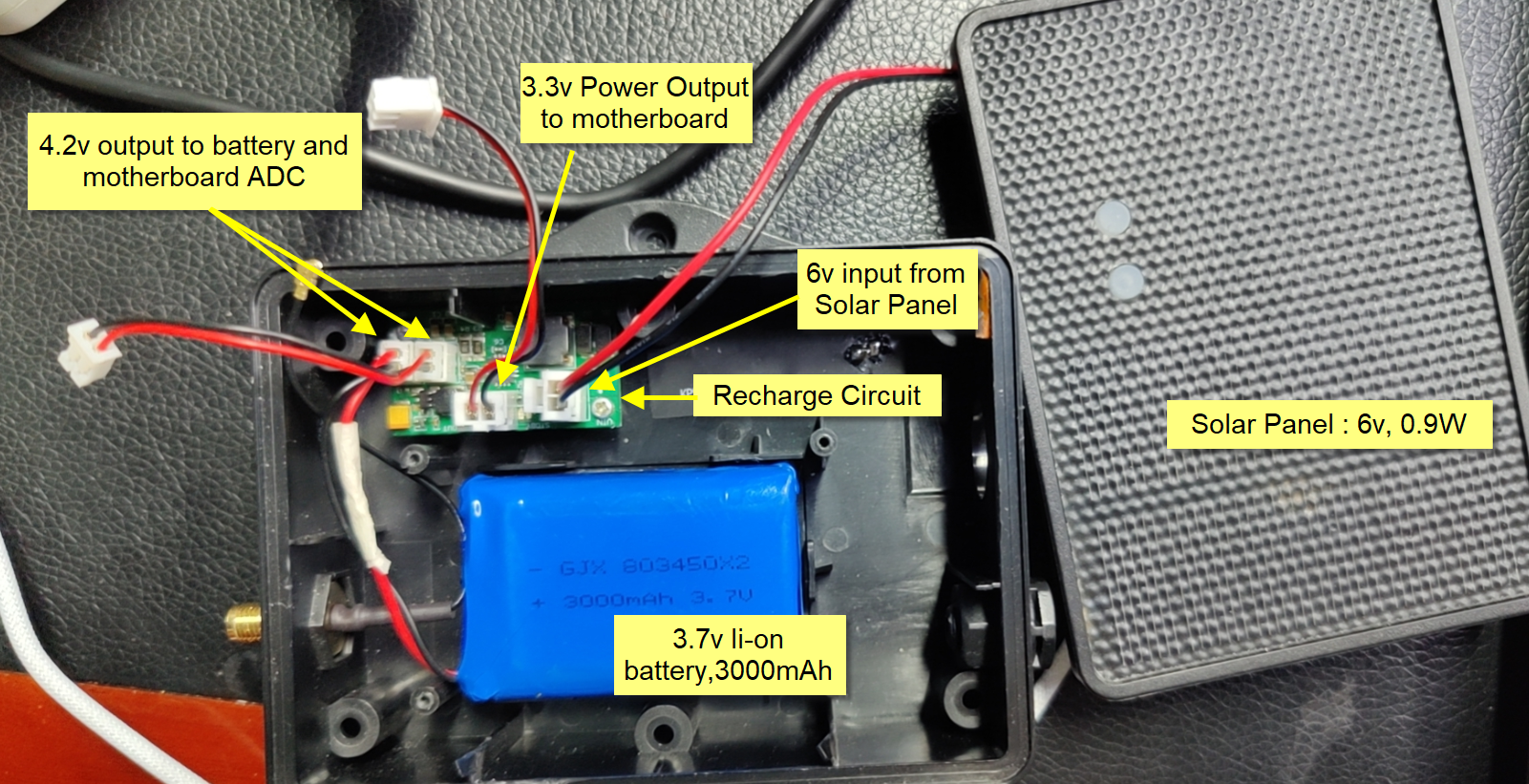
Below are the Internal Power Structure for -LS and -NS version.
3.2 Battery Info
The battery use in -LS and -NS version are 3.7v Li-ion rechargable battery . Dimension: 803450 x 2 , and 3000mAh capacity. The connector type is PH2.0 2 pin connector.
3.3 Solar Spec
- Solar Panel: Monocrystalline Silicon
- Dimension: 103 x 73 mm
- Max Power: 0.9 W
- Voltage at nominal power :5V (±5%)
- Current at nominal power: 180mA (±5%)
- Cell efficient : 22%
- UV resistance
3.4 Related Document
3.5 Recharge without Solar
If user wants to recharge the battery without Solar Panel. Below are the steps
a) Remove the 6v input from solar panel.
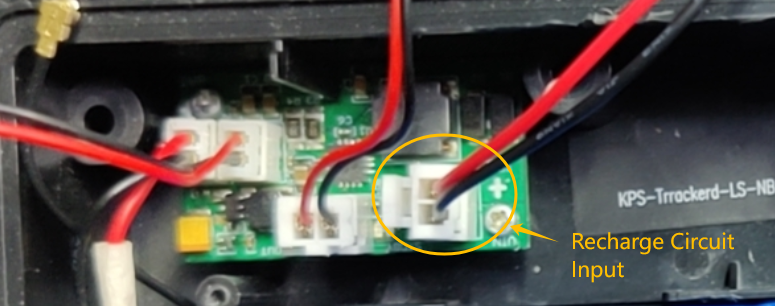
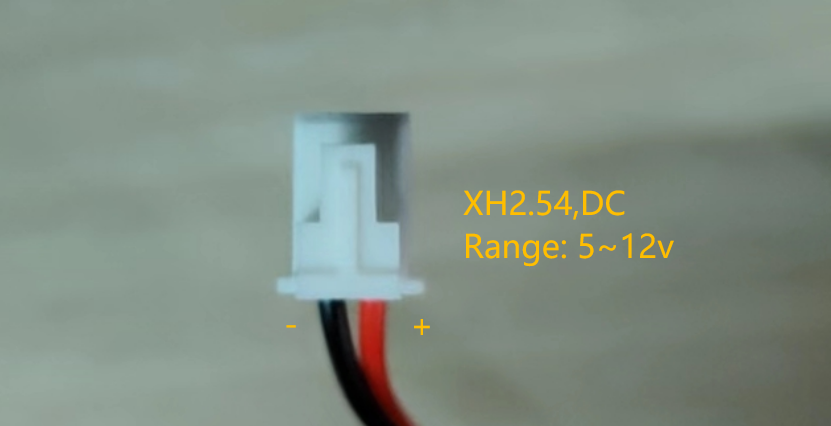
b) Provide voltage to this connector(XHB2.54-2P) to recharge the battery. (Input Range: DC: 5~12v)
4. Power Consumption Analyze
4.0 Notice of Battery Calculation
The battery calculations below are based on the following conditions:
a) Battery capacity as specified by the battery supplier.
b) Regular sampling and uplink intervals.
c) Normal ambient temperature of 25°C.
Please note that these calculations represent ideal conditions. Actual field performance may vary significantly due to various factors, including:
- Temperature: Low temperatures can reduce battery discharge efficiency and shorten overall battery life.
- Transmission Power Variation: Uplink power consumption is not constant. For example, in LoRaWAN, power usage differs greatly between DR0 and DR5, and both may occur during real-world operation. In NB-IoT, variations in signal strength can also lead to substantial differences in power consumption.
- Retransmissions: Occasional retransmissions during uplinks increase power consumption and can reduce the expected battery life.
4.1 Method 1: Use Our Calculate Table
Dragino Battery powered product are all runs in Low Power mode. We have an update battery calculator which base on the measurement of the real device. User can use this calculator to check the battery life and calculate the battery life if want to use different transmit interval.
Instruction to use as below: Step 1: Downlink the up-to-date DRAGINO_Battery_Life_Prediction_Table.xlsx from: https://www.dropbox.com/sh/zwex6i331j5oeq2/AACIMf9f_v2qsJ39CuMQ5Py_a?dl=0
Step 2: Open it and choose
- Product Model
- Uplink Interval
- Working Mode
And the Life expectation in difference case will be shown on the right.
4.2 Method 2: Manual Calcuation.
4.2.1 For -LB / -LS LoRaWAN models base on ASR6601
The power consumption mainly include three parts:
- Sleep Power : Most time the CPU are in sleep mode. It is around 6uA, So for one day, total power consumption: 6uA x 24(hour) = 144 uAh = 0.144mAh (base on batter output voltage)
- Watch Dog Current: Internal Water Dog to monitor Software state: this is very small and same for each device.** for one day**: 0.003mAH
- Sampling Power: The power consume to read sensor for each sampling.
- Example, SN50v3-LB connect to an external sensor, each reading need to use 5V , and sensor require current 10mA and 2 seconds. So each sampling need 10mA x 2 seconds / 3600 = 0.0056mAh ( base on 5v). Assume 90% converter rate from 3.3v to 5v) , we can consider the mAh in 3.3v is 0.0056mAh/90% = 0.0062mAh per sampling. If one day, SN50v3-LB read this sensor 3 times every hour. So for one day, the total power consumption is 0.0062mAh x 3 x 24 = 0.4464 mAh
- Transmit & Receive Power: this power consumption depends on the transmit power and the data rate (DR) settings. They are the same for all -LB and -LS series. Below are the reference
- EU868 band, TXP=0 (Max Power), DR=5 (Shortest Distance) : ~0.0028mAh (base on 3.3v) (per transmit + receive).
- EU868 band, TXP=0 (Max Power), DR=0 (Longest Distance) : ~0.044 mAh (base on 3.3v) (per transmit + receive).
So for SN50v3 with above sensor, we set 5V output to open 2 seconds every reading and set TDC = 20 minutes. So 72 reading and transmit every day
The total power consumption is
- EU868 , Good Signal : 0.144mAh + 0.003mAh + 0.0062mAh * 72 + 0.0028 mAh * 72 = 0.795 mAh per day. For the 8500mAh , if we consider 20% margin, we can use 8500mAh x 80% / 0.795mAh = 8553 days
- EU868 , Poor Signal: 0.144mAh + 0.003mAh + 0.0062mAh * 72 + 0.044 mAh * 72 = 3.7614 mAh per day, For the 8500mAh, if we consider 20% margin, we can use 8500mAh x 80% / 3.7614 mAh = 1807 days
Notice, actually deployment situation is more complicate and above calcualtion is base on lab. The calculation is only for reference. It doesn't response for the promising battery life.
4.3 Method 3: Use AI to calculate.
4.3.1 Battery Calculation Example by AI for -CB&CS series:
4.3.1.1 For -CB series
Take S31-CB as an example:
1. Questiones for AI:
Please conculate for Dragino CB series battery, below is the condition:
a) Battery Type: Li-SOCl2 , Capacity 8500mAh, self-discharge: 2%/year
b) Sleep Current: 19.618uA, Always happen
c) Watchdog Event: Current 693.345uA, Duration: 1ms
d) Sampling Current 68.176mA, Duration: 9.015s
d.1) CLOCKLOG function Sampling Current 8.54783mA, Duration: 127.456ms
e) Average current transmitted per uplink under different protocol conditions
e.1) UDP Protocol: Current 60.9679mA, Duration 27.398s
e.2) TCP Protocol: Current 63.4357mA, Duration 38.115s
e.3) MQTT Protocol: Current 63.1385mA, Duration 35.485s
e.4) COAP Protocol: Current 63.9749mA, Duration 35.661s
f) How often the device will send an uplink : 120 minutes
g) How many sampling per uplink : 1 Sampling per uplink
h) CLOCKLOG function sampling interval: 15 minutes per sample
Please calucate the battery life for different condition.
2. Example Result:
Please see below for the battery life for different mode. The transmit should happen between different mode, so the battery life will between the longest and shortest time.
Please note the calculation is ideal case, in real world deployment the calculation will be more complicate. So the battery life time might be shorter than ideal calculation.

4.3.1.2 For CS series
1. Questiones for AI(Take S31-CS as an example):
Please conculate for Dragino CS series battery, below is the condition:
a) Battery Type: Lithium-ion , Capacity 3000mAh, self-discharge: 2%/year
b) Sleep Current: 50uA, Always happen
c) Watchdog Event: Current 693.345uA, Duration: 1ms
d) Sampling Current 68.176mA, Duration: 9.015s
d.1) CLOCKLOG function Sampling Current 8.54783mA, Duration: 127.456ms
e) Average current transmitted per uplink under different protocol conditions
e.1) UDP Protocol: Current 60.9679mA, Duration 27.398s
e.2) TCP Protocol: Current 63.4357mA, Duration 38.115s
e.3) MQTT Protocol: Current 63.1385mA, Duration 35.485s
e.4) COAP Protocol: Current 63.9749mA, Duration 35.661s
f) How often the device will send an uplink : 120 minutes
g) How many sampling per uplink : 1 Sampling per uplink
h) CLOCKLOG function sampling interval: 15 minutes per sample
Please calucate the battery life for different condition.
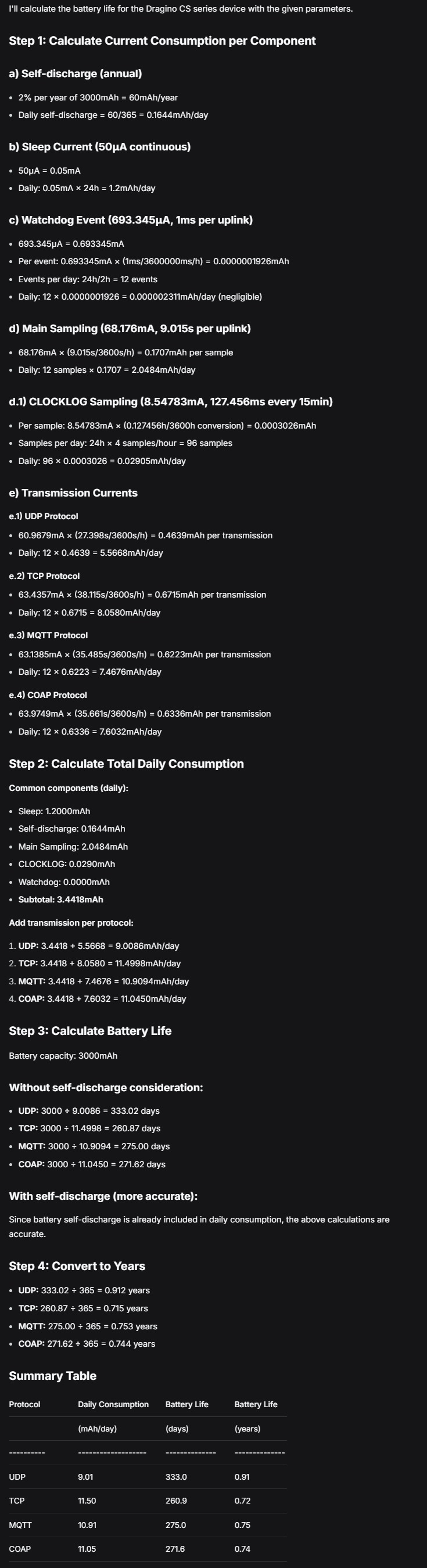
2. Example Result:
Please see below for the battery life for different mode. The transmit should happen between different mode, so the battery life will between the longest and shortest time.
Please note the calculation is ideal case, in real world deployment the calculation will be more complicate. So the battery life time might be shorter than ideal calculation.
4.3.2 Battery Calculation Example by AI for -LB&LS series:
4.3.2.1 For -LB series
Take S31x-LB as an example:
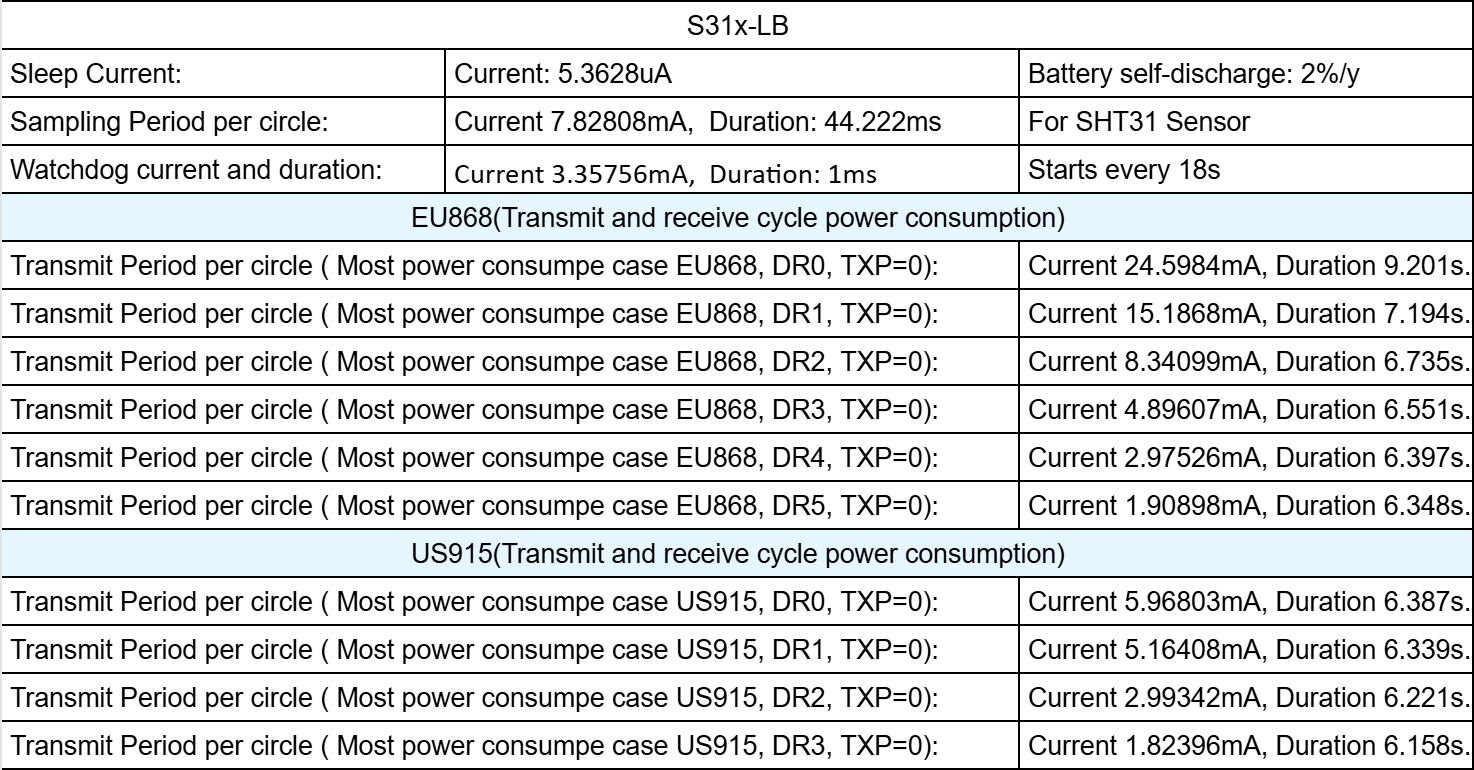
**For EU868 Frequency: 1. Questiones for AI: **
Please conculate for Dragino LB series battery, below is the condition:
a) Battery Type: Li-SOCl2 , Capacity 8500mAh, self-discharge: 2%/year
b) Sleep Current: 6uA, Always happen
c) Watchdog Event: Current 3.35756mA, Duration: 1ms
d) Sampling Current: 8mA, Duration 0.04 seconds
e) Transmit Average Current @ difference condition for each uplink, include TX and RX ,
e.1) EU868, DR0, TXP=0: Current 24.5984mA, Duration 9.201s.
e.2) EU868, DR1, TXP=0: Current 15.1868mA, Duration 7.194s.
e.3) EU868, DR2, TXP=0: Current 8.34099mA, Duration 6.735s.
e.4) EU868, DR3, TXP=0: Current 4.89607mA, Duration 6.551s.
e.5) EU868, DR4, TXP=0: Current 2.97526mA, Duration 6.397s.
e.6) EU868, DR5, TXP=0: Current 1.90898mA, Duration 6.348s.
f) How often the device will send an uplink : 20 minutes
g) How many sampling per uplink : 1 Sampling per uplink
Please calucate the battery life for different condition.
2. Example Result
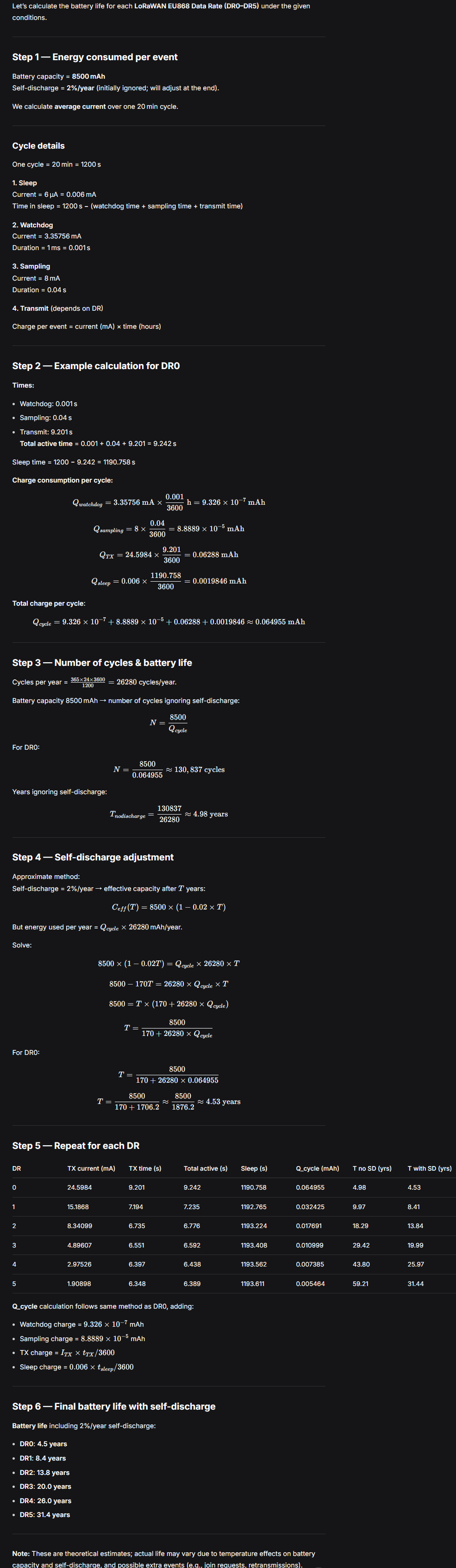
Please see below for the battery life for different mode. The transmit should happen between different mode, so the battery life will between the longest and shortest time.
Please note the calculation is ideal case, in real world deployment the calculation will be more complicate. So the battery life time might be shorter than ideal calculation.
**For US915 Frequency: 1. Questiones for AI: **
Please conculate for Dragino LB series battery, below is the condition:
a) Battery Type: Li-SOCl2 , Capacity 8500mAh, self-discharge: 2%/year
b) Sleep Current: 6uA, Always happen
c) Watchdog Event: Current 3.35756mA, Duration: 1ms
d) Sampling Current: 8mA, Duration 0.04 seconds
e) Transmit Average Current @ difference condition for each uplink, include TX and RX ,
e.1) US915, DR0, TXP=0: Current 5.96803mA, Duration 6.387s.
e.2) US915, DR1, TXP=0: Current 5.16408mA, Duration 6.339s.
e.3) US915, DR2, TXP=0: Current 2.99342mA, Duration 6.221s.
e.4) US915, DR3, TXP=0: Current 1.82396mA, Duration 6.158s.
f) How often the device will send an uplink : 20 minutes
g) How many sampling per uplink : 1 Sampling per uplink
Please calucate the battery life for different condition.
2. Example Result
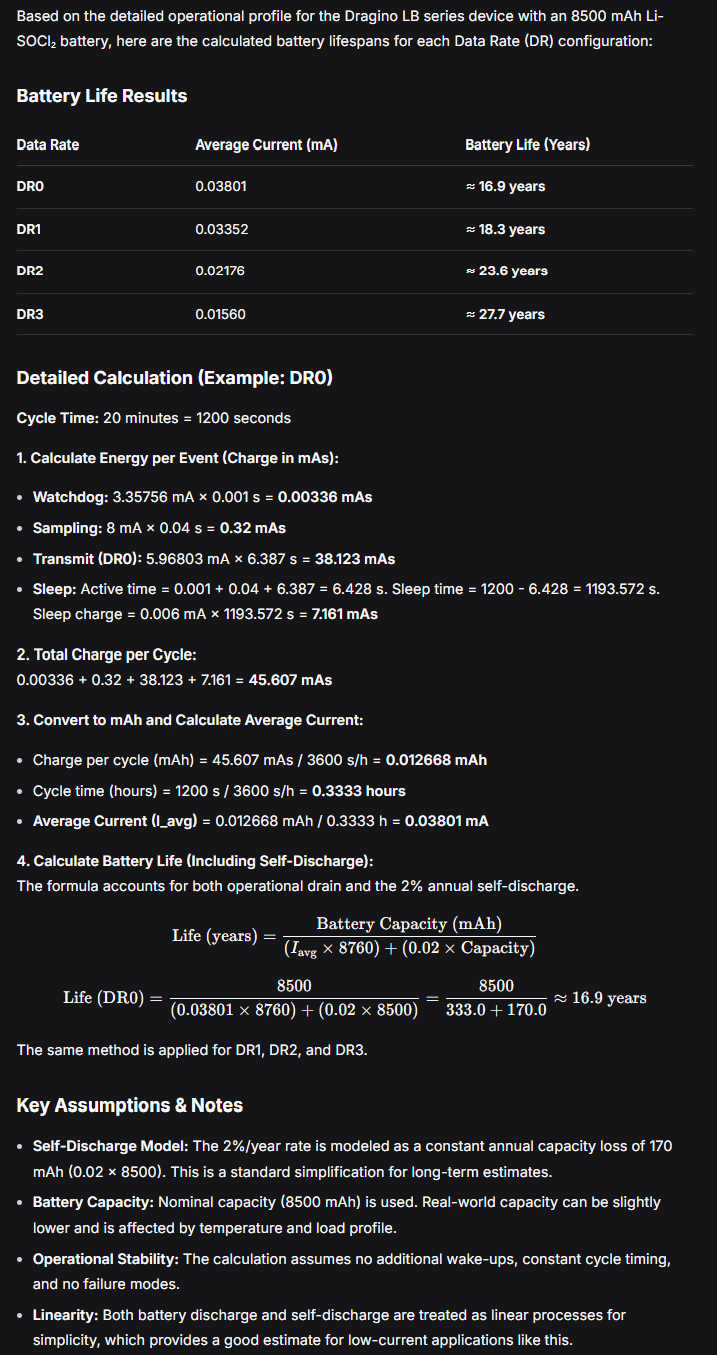
Please see below for the battery life for different mode. The transmit should happen between different mode, so the battery life will between the longest and shortest time.
Please note the calculation is ideal case, in real world deployment the calculation will be more complicate. So the battery life time might be shorter than ideal calculation.
4.3.2.1 For -LS series
Take S31x-LS as an example:
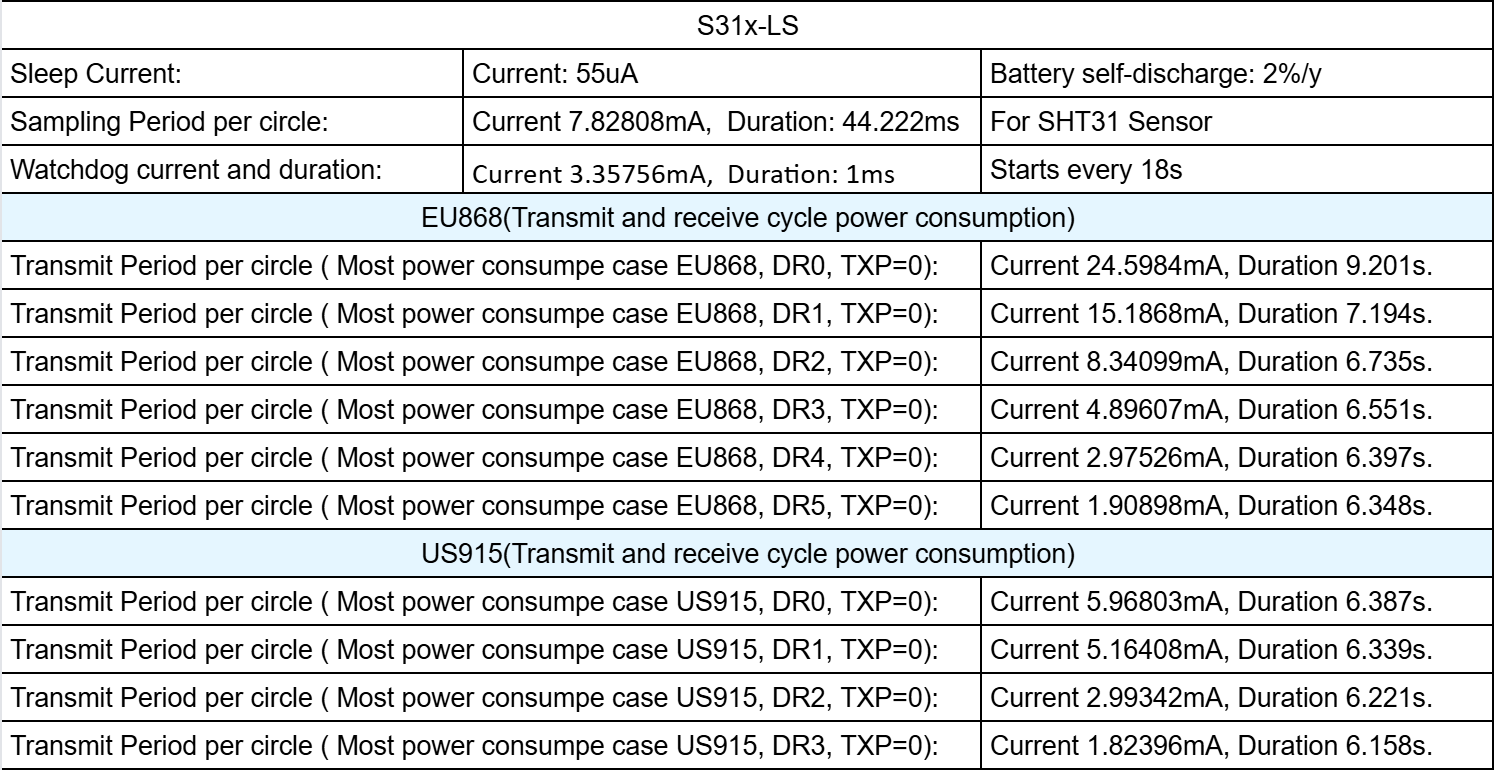
**For EU868 Frequency: 1. Questiones for AI: **
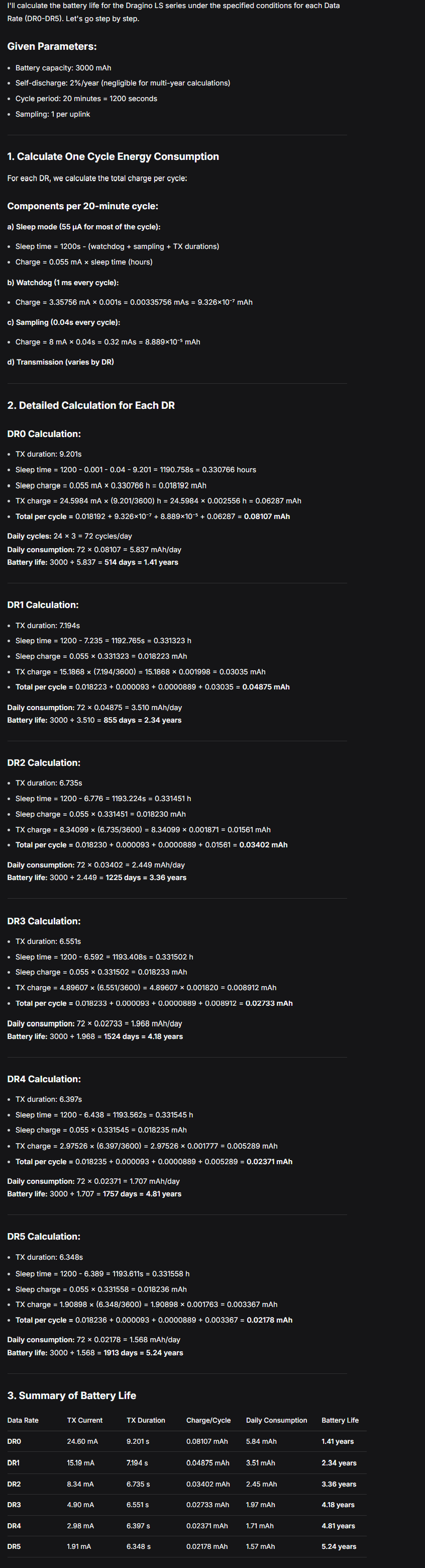
Please conculate for Dragino LS series battery, below is the condition:
a) Battery Type: Lithium-ion , Capacity 3000mAh, self-discharge: 2%/year
b) Sleep Current: 55uA, Always happen
c) Watchdog Event: Current 3.35756mA, Duration: 1ms
d) Sampling Current: 8mA, Duration 0.04 seconds
e) Transmit Average Current @ difference condition for each uplink, include TX and RX ,
e.1) EU868, DR0, TXP=0: Current 24.5984mA, Duration 9.201s.
e.2) EU868, DR1, TXP=0: Current 15.1868mA, Duration 7.194s.
e.3) EU868, DR2, TXP=0: Current 8.34099mA, Duration 6.735s.
e.4) EU868, DR3, TXP=0: Current 4.89607mA, Duration 6.551s.
e.5) EU868, DR4, TXP=0: Current 2.97526mA, Duration 6.397s.
e.6) EU868, DR5, TXP=0: Current 1.90898mA, Duration 6.348s.
f) How often the device will send an uplink : 20 minutes
g) How many sampling per uplink : 1 Sampling per uplink
Please calucate the battery life for different condition.
2. Example Result
Please see below for the battery life for different mode. The transmit should happen between different mode, so the battery life will between the longest and shortest time.
Please note the calculation is ideal case, in real world deployment the calculation will be more complicate. So the battery life time might be shorter than ideal calculation.
1. Questiones for AI: For US915 Frequency:
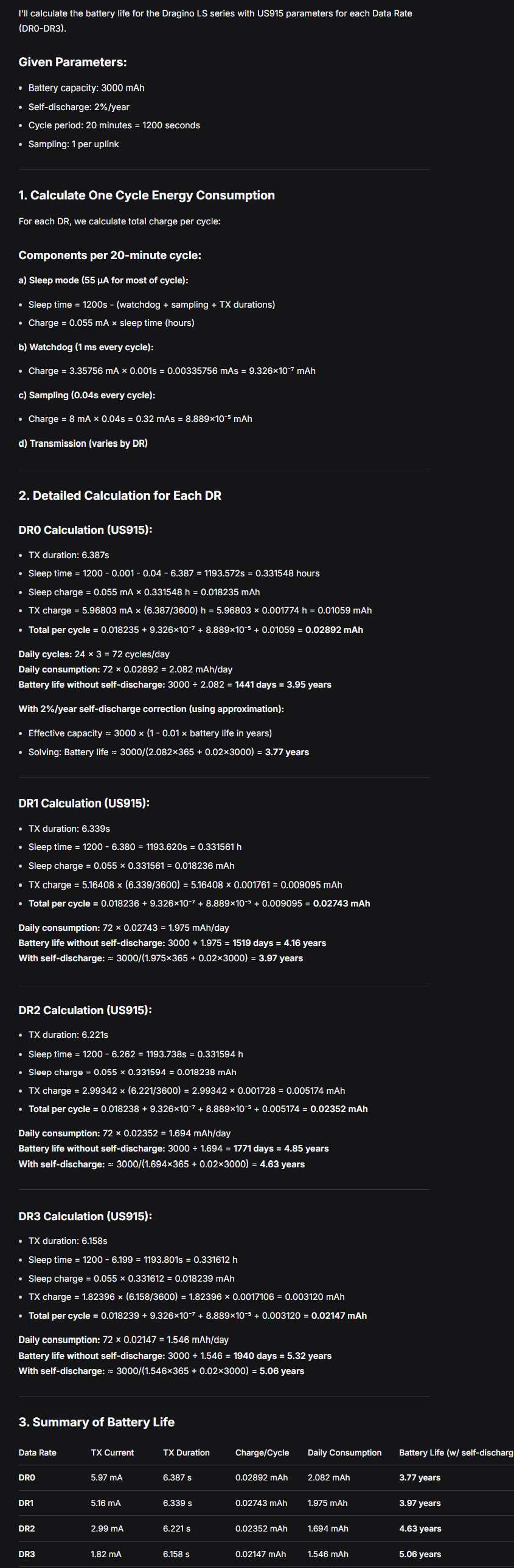
Please conculate for Dragino LS series battery, below is the condition:
a) Battery Type: Lithium-ion , Capacity 3000mAh, self-discharge: 2%/year
b) Sleep Current: 55uA, Always happen
c) Watchdog Event: Current 3.35756mA, Duration: 1ms
d) Sampling Current: 8mA, Duration 0.04 seconds
e) Transmit Average Current @ difference condition for each uplink, include TX and RX ,
e.1) US915, DR0, TXP=0: Current 5.96803mA, Duration 6.387s.
e.2) US915, DR1, TXP=0: Current 5.16408mA, Duration 6.339s.
e.3) US915, DR2, TXP=0: Current 2.99342mA, Duration 6.221s.
e.4) US915, DR3, TXP=0: Current 1.82396mA, Duration 6.158s.
f) How often the device will send an uplink : 20 minutes
g) How many sampling per uplink : 1 Sampling per uplink
Please calucate the battery life for different condition.
2. Example Result
Please see below for the battery life for different mode. The transmit should happen between different mode, so the battery life will between the longest and shortest time.
Please note the calculation is ideal case, in real world deployment the calculation will be more complicate. So the battery life time might be shorter than ideal calculation.
4.3.3 Battery Calculation Example by AI for -NB&NS series:
4.3.3.1 For -NB series
Take S31-NB as an example:
**1. Questiones for AI: **
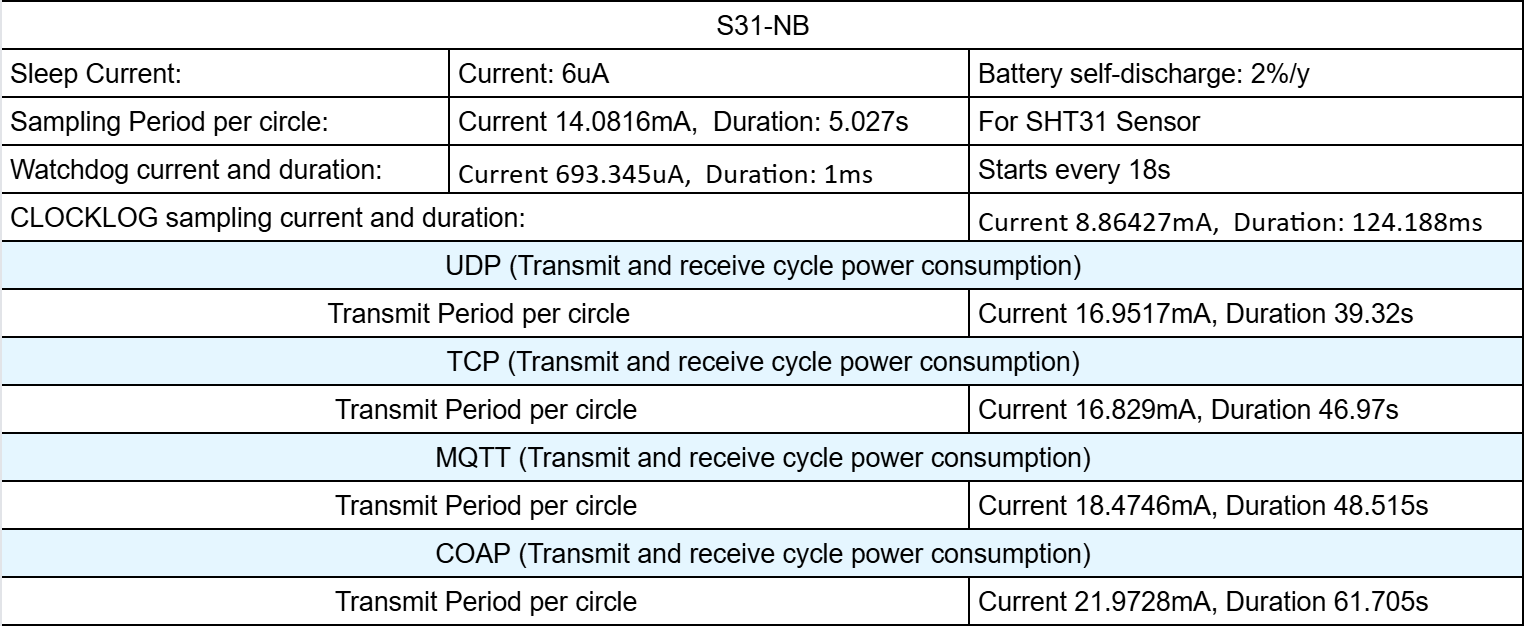
Please conculate for Dragino NB series battery, below is the condition:
a) Battery Type: Li-SOCl2 , Capacity 8500mAh, self-discharge: 2%/year
b) Sleep Current: 5uA, Always happen
c) Watchdog Event: Current 693.345uA, Duration: 1ms
d) Sampling Current 14.0816mA, Duration: 5.027s
d.1) CLOCKLOG function Sampling Current 8.86427mA, Duration: 124.188ms
e) Average current transmitted per uplink under different protocol conditions
e.1) UDP Protocol: Current 16.9517mA, Duration 39.32s
e.2) TCP Protocol: Current 16.829mA, Duration 46.97s
e.3) MQTT Protocol: Current 18.4746mA, Duration 48.515s
e.4) COAP Protocol: Current 21.9728mA, Duration 61.705s
f) How often the device will send an uplink : 120 minutes
g) How many sampling per uplink : 1 Sampling per uplink
h) CLOCKLOG function sampling interval: 15 minutes per sample
Please calucate the battery life for different condition.
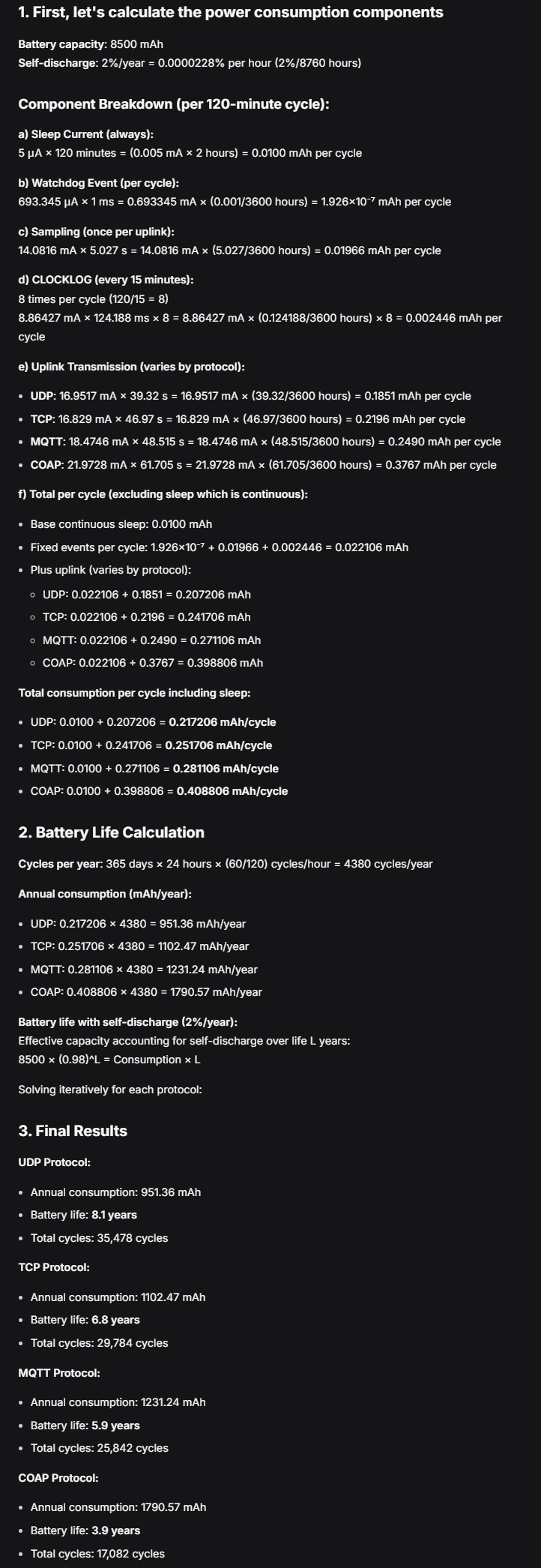
2. Example Result
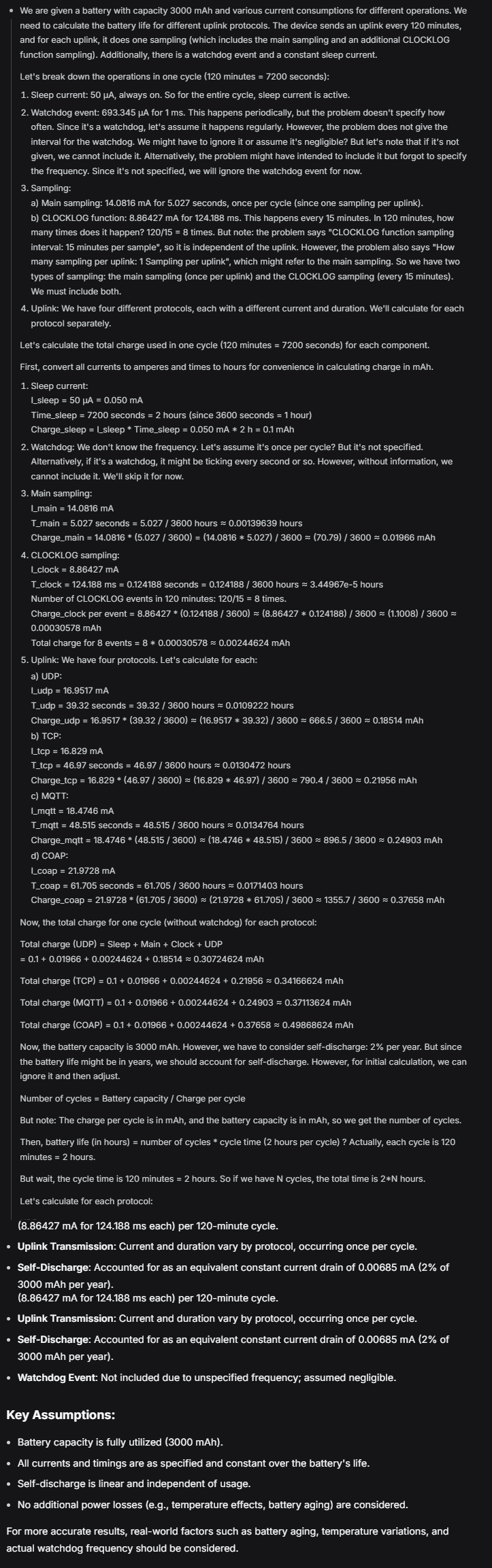
Please see below for the battery life for different mode. The transmit should happen between different mode, so the battery life will between the longest and shortest time.
Please note the calculation is ideal case, in real world deployment the calculation will be more complicate. So the battery life time might be shorter than ideal calculation.
4.3.3.2 For -NS series
Take S31-NS as an example:
**1. Questiones for AI: **
Please conculate for Dragino NS series battery, below is the condition:
a) Battery Type: Lithium-ion , Capacity 3000mAh, self-discharge: 2%/year
b) Sleep Current: 50uA, Always happen
c) Watchdog Event: Current 693.345uA, Duration: 1ms
d) Sampling Current 14.0816mA, Duration: 5.027s
d.1) CLOCKLOG function Sampling Current 8.86427mA, Duration: 124.188ms
e) Average current transmitted per uplink under different protocol conditions
e.1) UDP Protocol: Current 16.9517mA, Duration 39.32s
e.2) TCP Protocol: Current 16.829mA, Duration 46.97s
e.3) MQTT Protocol: Current 18.4746mA, Duration 48.515s
e.4) COAP Protocol: Current 21.9728mA, Duration 61.705s
f) How often the device will send an uplink : 120 minutes
g) How many sampling per uplink : 1 Sampling per uplink
h) CLOCKLOG function sampling interval: 15 minutes per sample
Please calucate the battery life for different condition.
2. Example Result
Please see below for the battery life for different mode. The transmit should happen between different mode, so the battery life will between the longest and shortest time.
Please note the calculation is ideal case, in real world deployment the calculation will be more complicate. So the battery life time might be shorter than ideal calculation.
4.3.4 What need to change to actually device**. **
Normally user need to change these two parameters base on their device:
--Sampling Current
--How often to send a uplink
--How many sampling for each uplink
5. Debug for Battery running out shortly
Below factors will affect the battery life. If the battery runs out very fast unexpectedly. Please check below points:
- Did you connect an external sensor? What is the power consumption of this sensor?
- What is the uplink period of the end node?
- What is the DataRate the sensor used to uplink?
- Does the sensor sends re-transmit too oftern? See this link for a possible issue with LoRaWAN server.
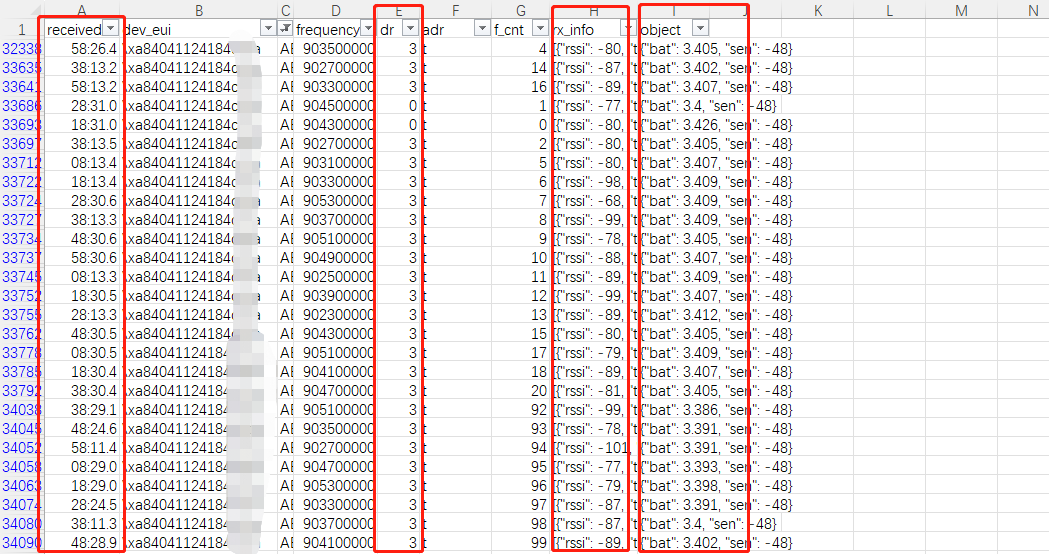
User can also send us (support(at)dragino.com) record so check. a record like below with the info:** Battery**, uplink time, DR.
6. FAQ
This section contains some frequently asked questions, which can help you resolve common issues and find solutions quickly.
6.1 Battery Protection State (Apply to Solar Panel + Li-ion battery)
The device cannot power on and the LED does not light up. Is the battery dead?
Not necessarily. If your device uses the Solar Panel + Li-ion battery configuration, the built-in battery management system includes a protection mechanism. The battery may enter a protection state due to reasons such as a temporary short circuit, overcurrent, or other internal conditions. In this state, the device will appear to be completely unresponsive.
**Solution: **
The solution is simple and requires no tools: Expose the device's solar panel to direct, strong sunlight. The battery protection state can often be reset quickly under sufficient sunlight, allowing the device to resume normal operation shortly after.
[Note: If the device still fails to power on after sufficient sunlight exposure, please check other troubleshooting sections or contact support.]
[ ]
6.2 Transmission power consumption
6.2.1 For LB&LS Series Transmission Power Consumption
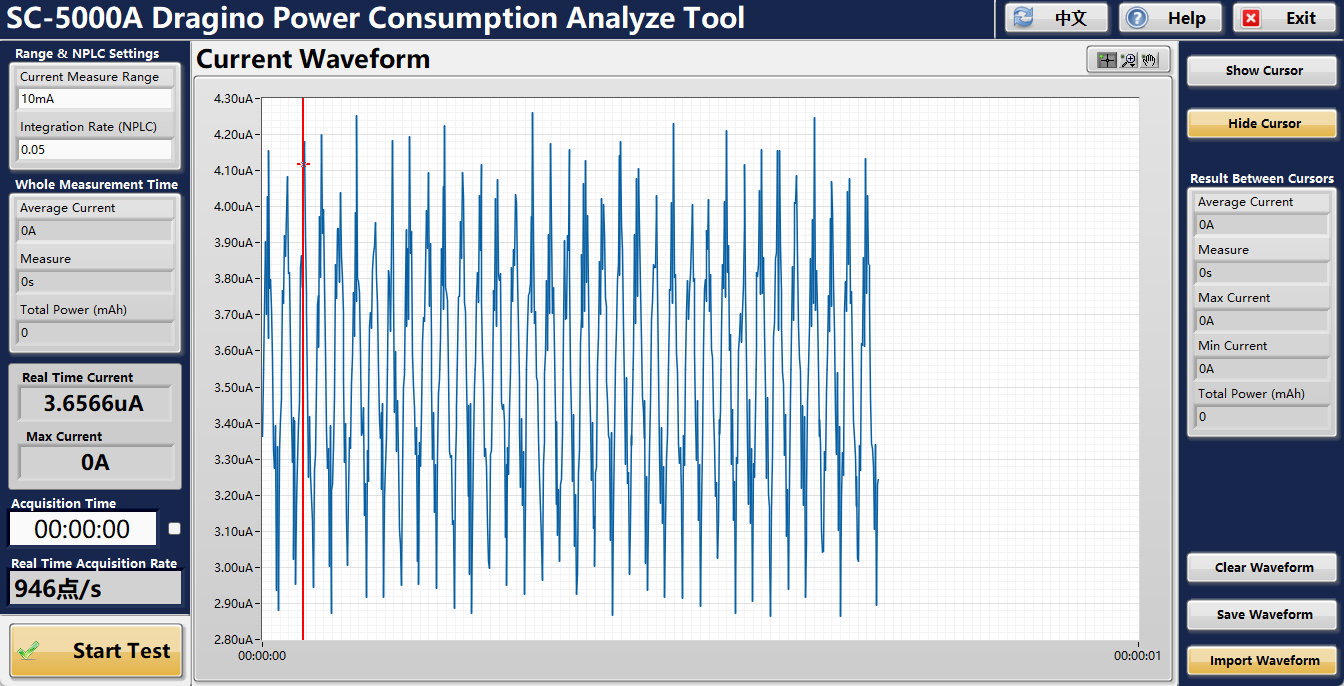
For the low power consumption of the S31x-LB Sleep current: 3.6 μA
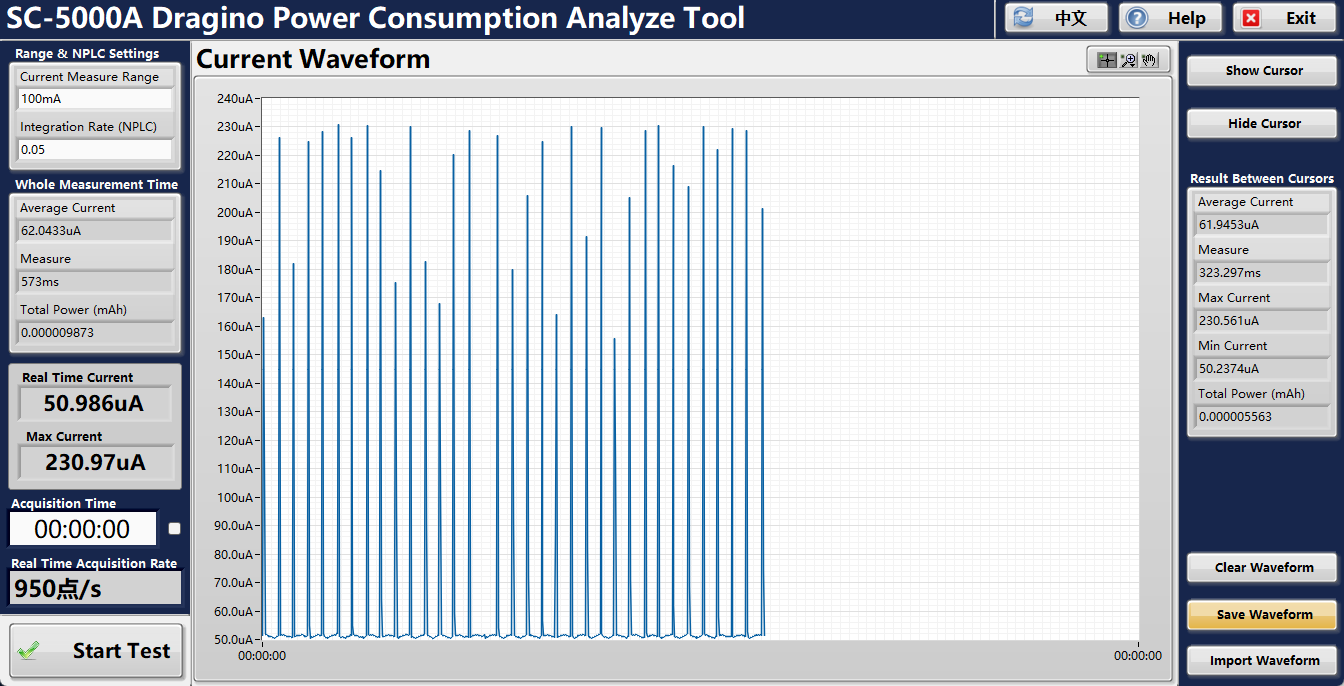
For the low power consumption of the S31x-LS Sleep current: 50 μA
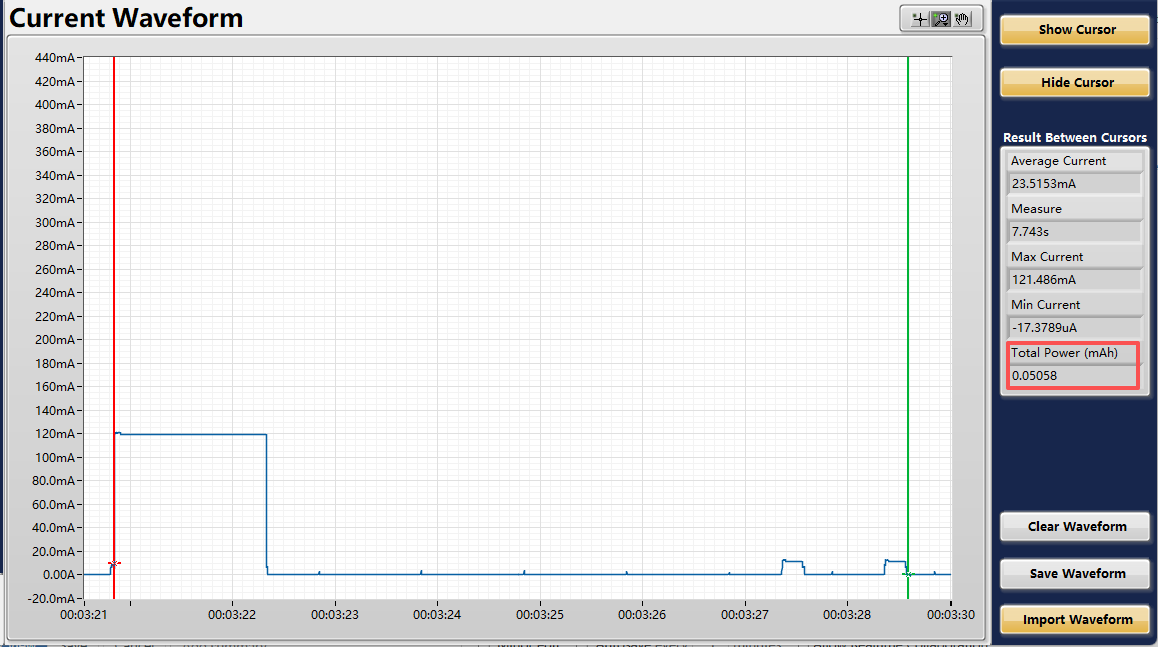
For the S31x-LB&LS EU868 frequency,
ADR=0, DR=0, TXP=0
Transmission power consumption: 0.05058mAh@3.6V
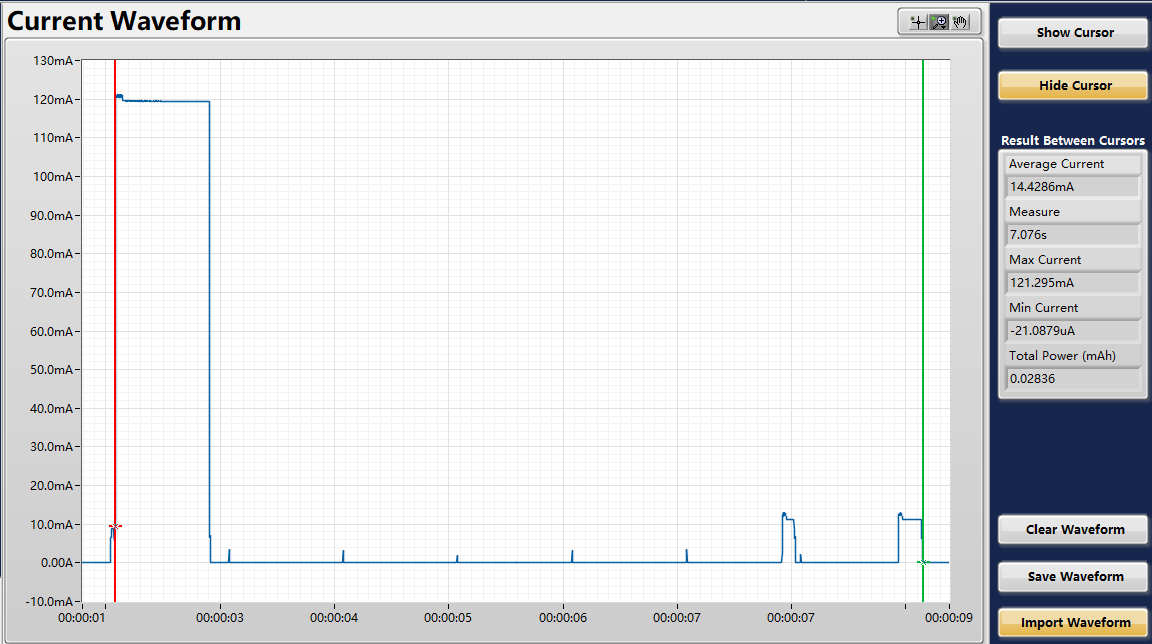
ADR=0, DR=1, TXP=0
Transmission power consumption: 0.02836mAh@3.6V
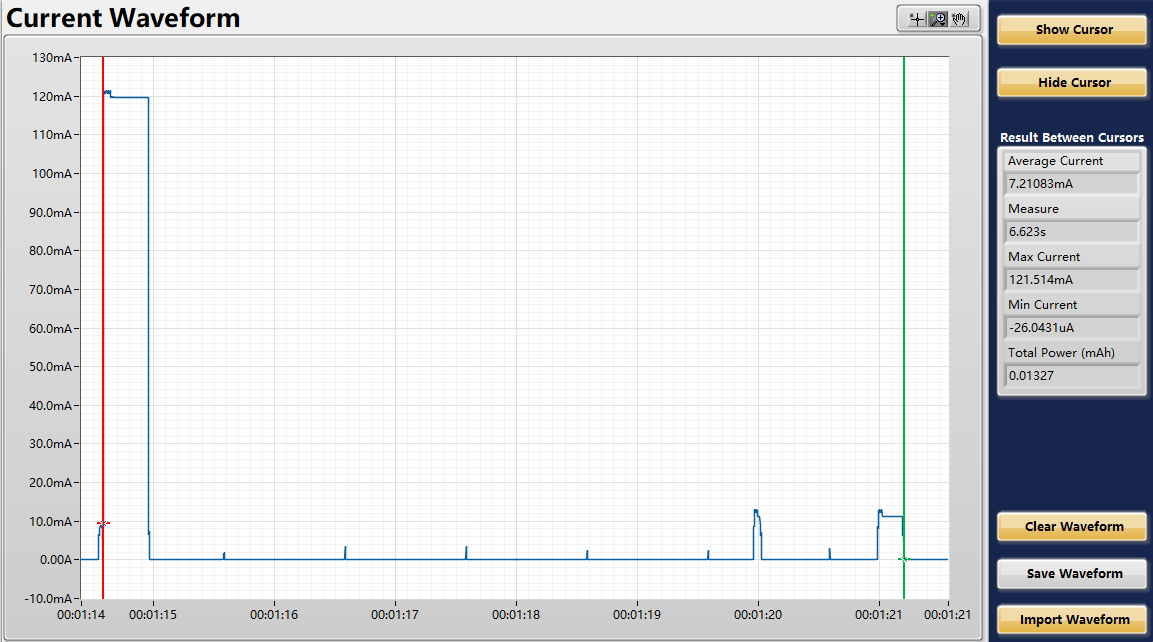
ADR=0, DR=2, TXP=0
Transmission power consumption: 0.01327mAh@3.6V
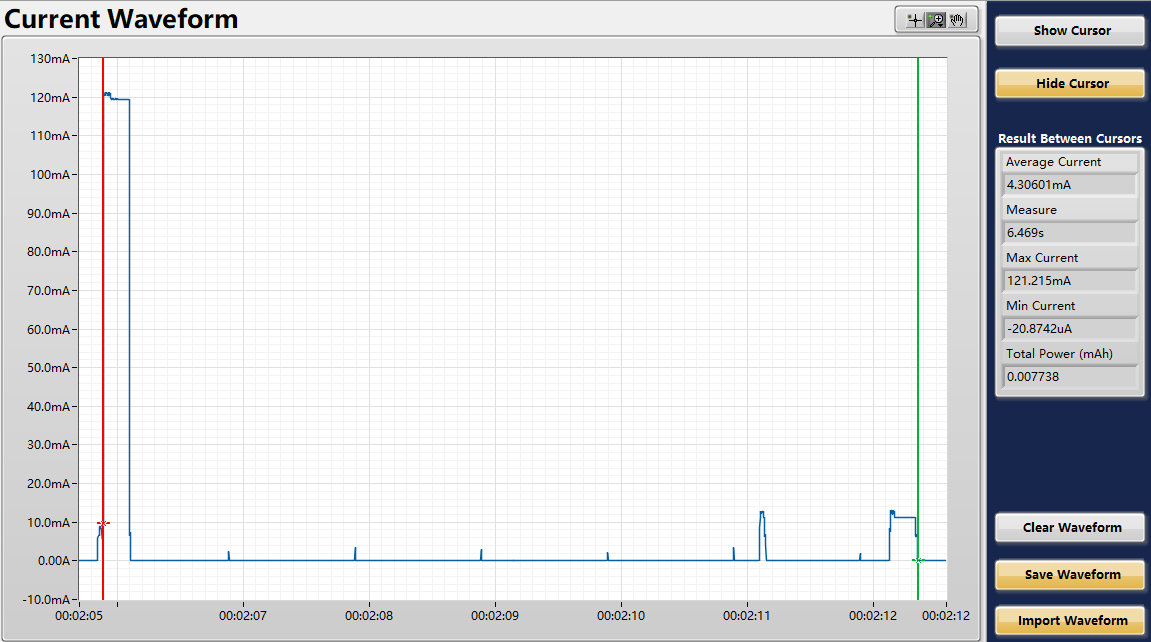
ADR=0, DR=3, TXP=0
Transmission power consumption: 0.007738mAh@3.6V
ADR=0, DR=4, TXP=0
Transmission power consumption: 0.004608mAh@3.6V
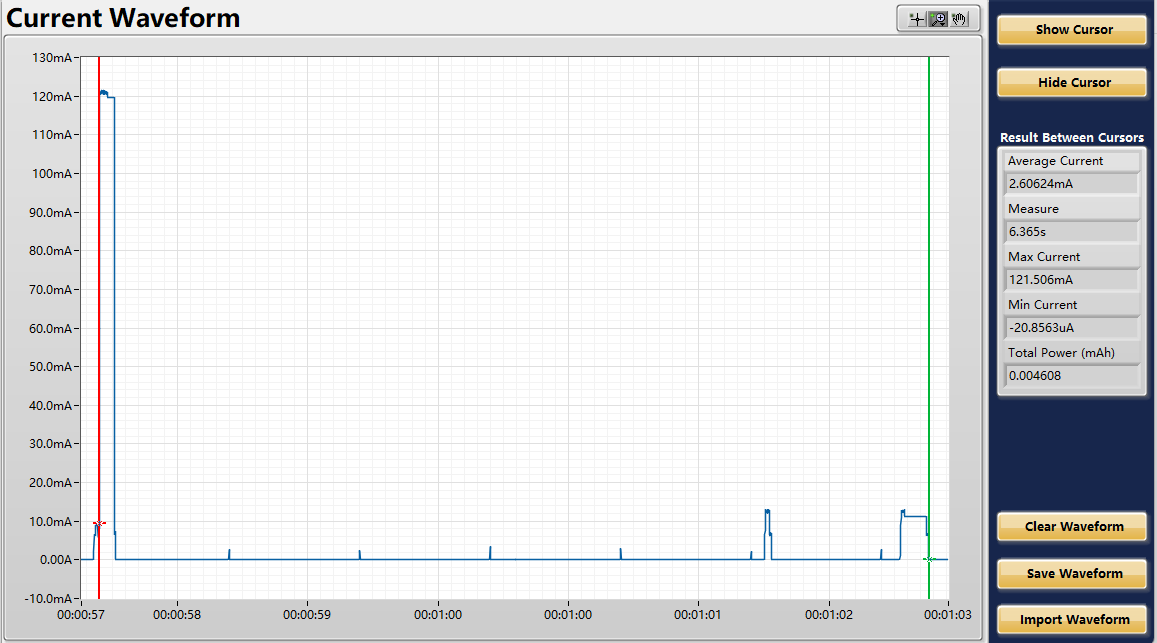
ADR=0, DR=5, TXP=0
Transmission power consumption: 0.002917mAh@3.6V
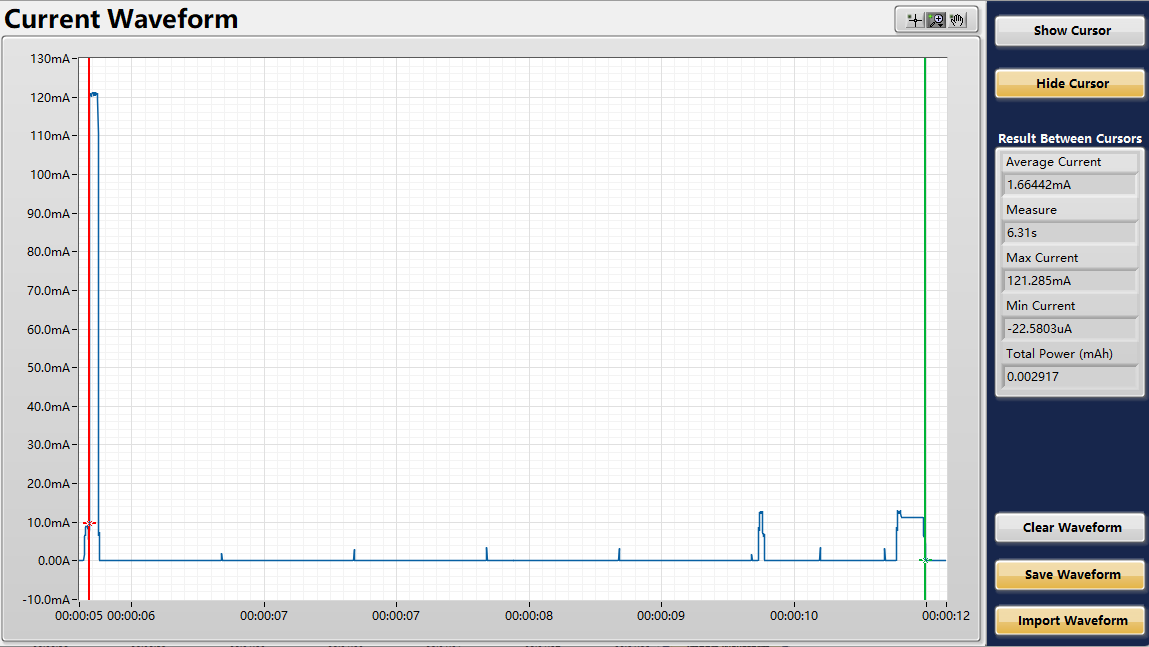
For the S31x-LB&LS US915 frequency,
ADR=0, DR=0, TXP=0
Transmission power consumption: 0.01471mAh@3.6V
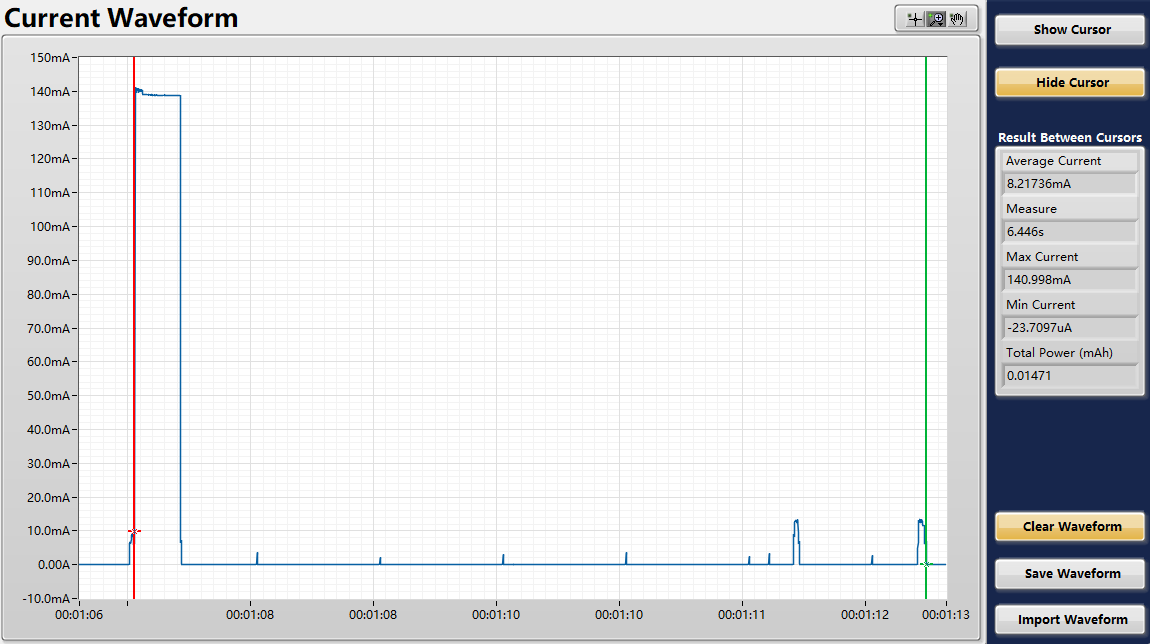
ADR=0, DR=1, TXP=0
Transmission power consumption: 0.008349mAh@3.6V
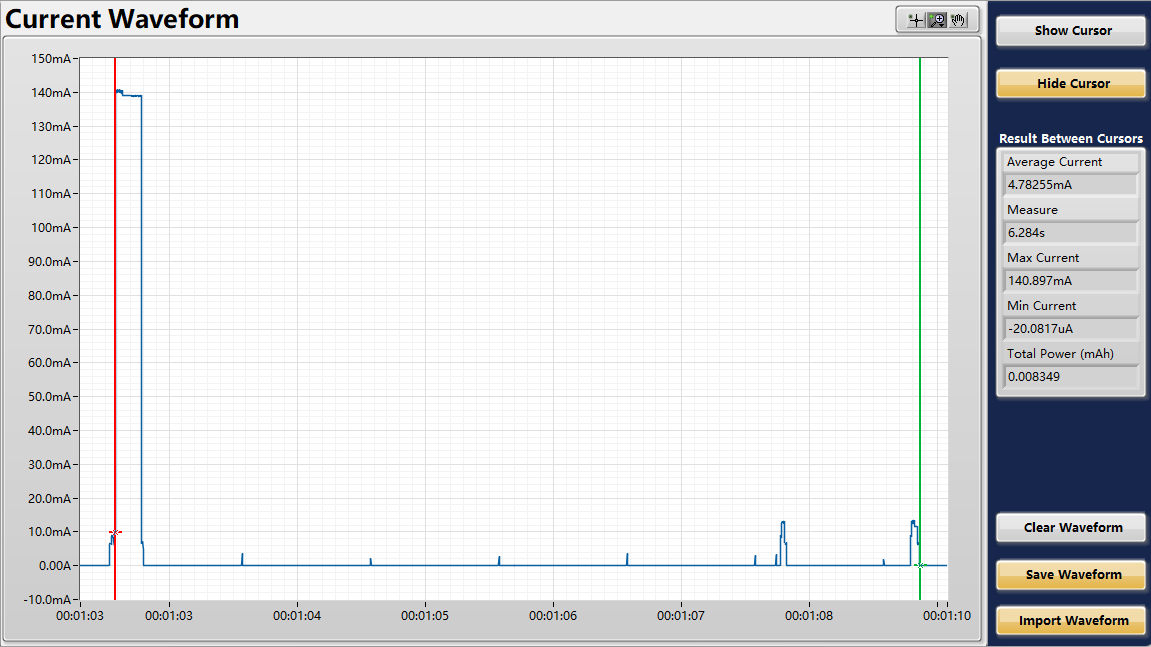
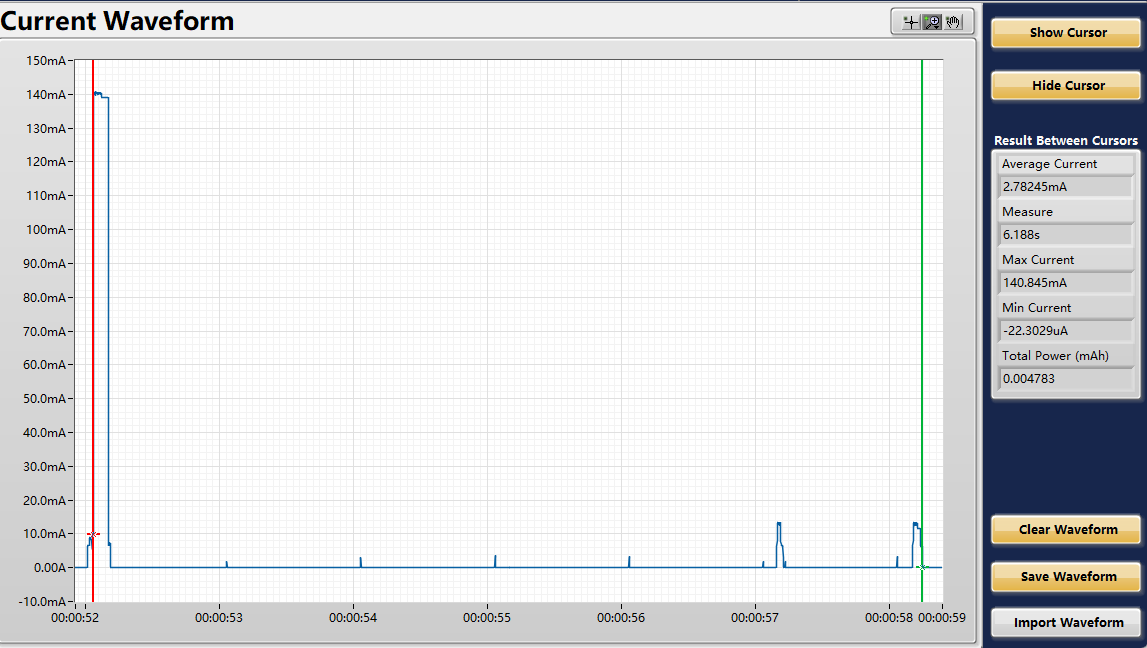
ADR=0, DR=2, TXP=0
Transmission power consumption: 0.004783mAh@3.6V
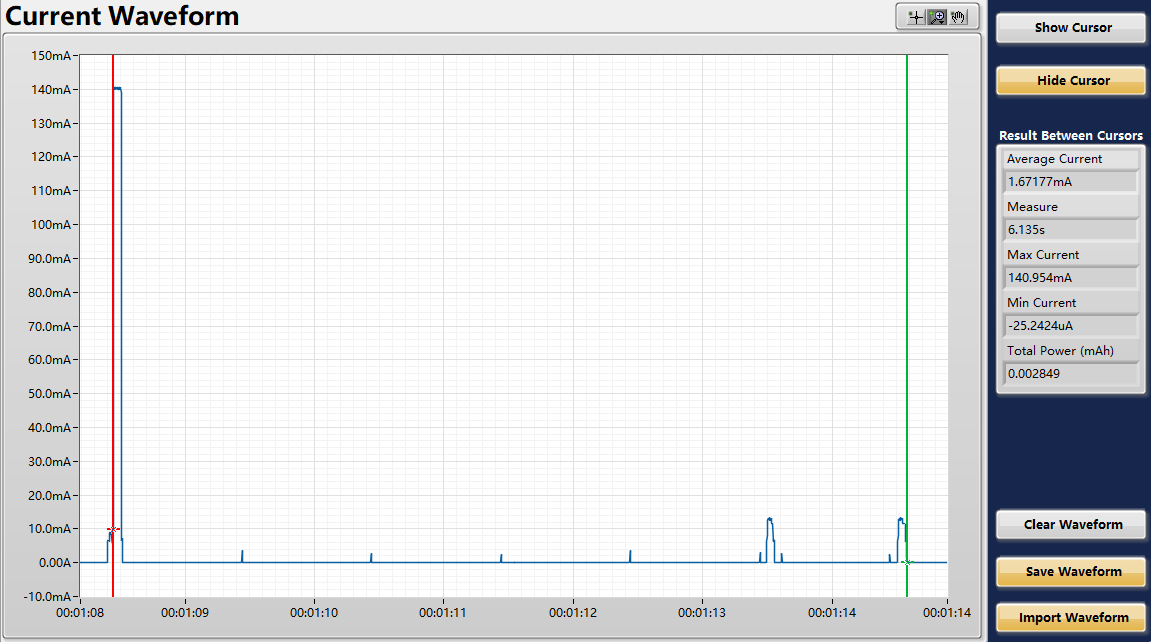
ADR=0, DR=3, TXP=0
Transmission power consumption: 0.002849mAh@3.6V
6.2.1 For NB&NS Series Transmission Power Consumption
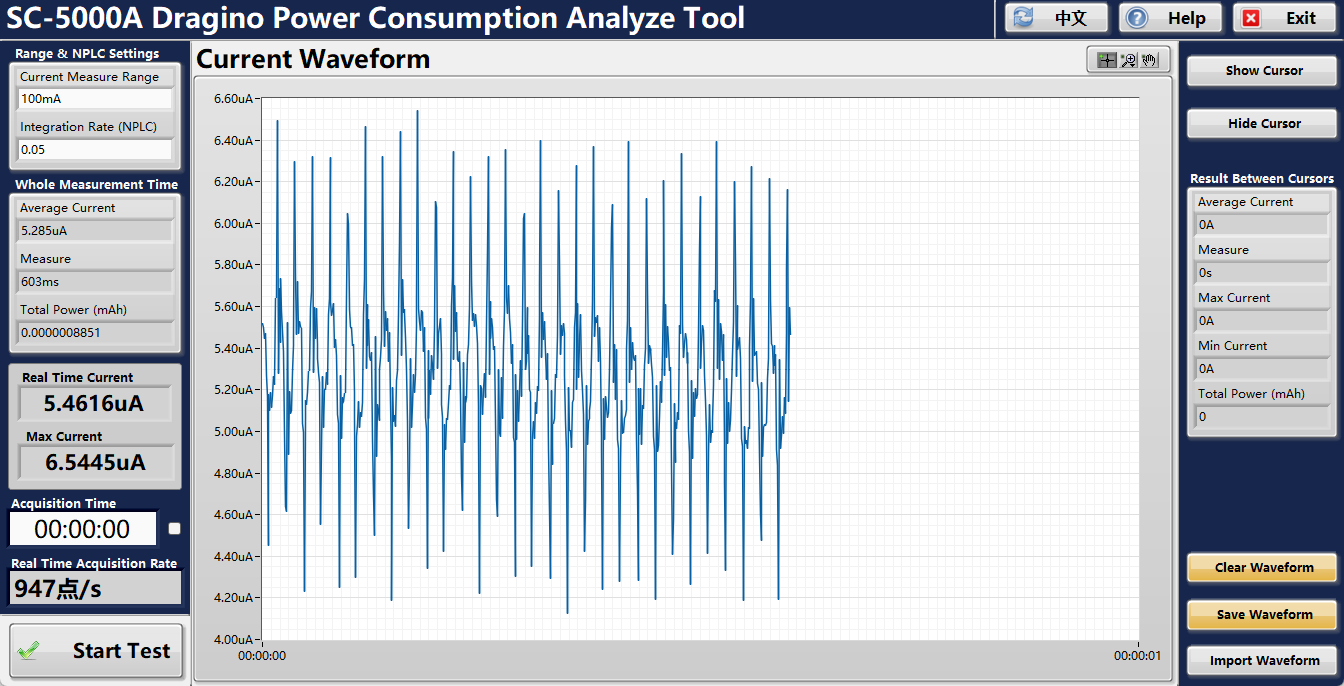
For the low power consumption of the S31x-NB Sleep current: 5.4 μA
For the low power consumption of the S31x-NS Sleep current: 52 μA
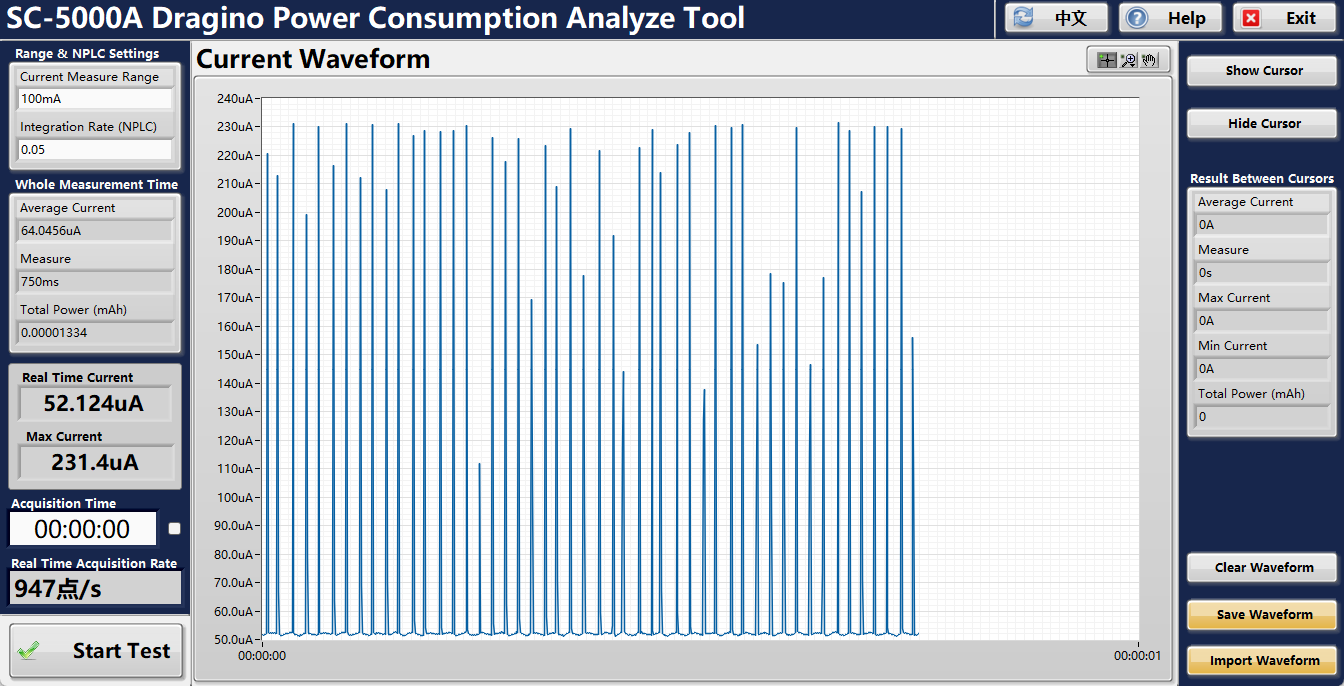
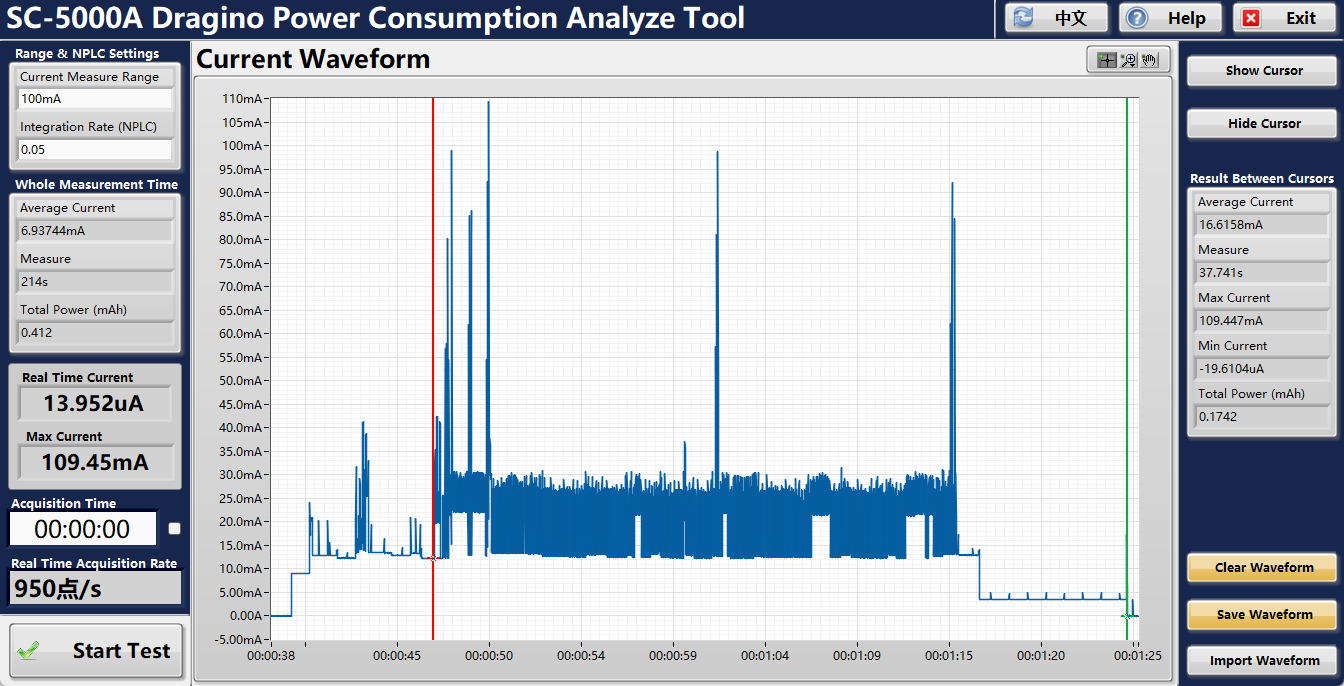
For the UDP uplink protocol of S31x-NB&NS
::: like-container